Showing posts with label war. Show all posts

Saturday, January 23, 2010

Ellroy in Afghanistan, or conspiracies we can believe in.

As I’ve no doubt tediously mentioned in the past, I’m a James Ellroy fan. At Christmas I bought his most recent book, Blood's a Rover. It is the third part of his Underworld U.S.A. trilogy – a sort of alternative history to American history in the 1950s and 60s. A couple of years ago I re-read the second in part of the trilogy, The Cold Six Thousand, and decided that it is one of my favourite books. I then decided I should re-read the first part of the trilogy as well, American Tabloid, so ordered at copy of my own realising I must have borrowed it from someone originally. I finished this re-read just a couple of days back: a dark and wonderful whirl of Cuban exiles, corrupt FBI men, killing-krazed klansmen, ridiculous and violent Mafioso, sleazy lounge singers and brutal gun slingers. Jack the hair, Bobby the dark knight, Fidel the beard, J. Edgar Hoover, Jack Ruby and his dogs all get walk-on roles. Everyone lies, everyone cheats, nothing is at it seems. Forces are in play and those who know about them have no wish to stop them. The denouement, of course, takes place at Dealey Plaza, Dallas, as shots ring out from the Texas book depository.

The vortex of interests and conspiracies are so richly entwined, having finished it I thought I might read the first and last chapters of The Cold Six Thousand for a third time, just to remind myself before diving in to Blood’s a Rover. Of course, it seemed silly to stop after just the first chapter so I’m now 100 pages and will re-read it all once more, just to really be warmed up for the final and supposedly masterful part of this dark trilogy. You just have to keep reminding yourself that this is fiction, and fiction from a depraved-if genius-mind, not history. We were talking about the Bildeberg conspiracy today, and how this old chestnut refuses to die. Probably sooner or later Google will lead a true believer to this post and they can tell me how I have been suckered by the deep forces of global Jewish bankers, space alien lizards or whatever their particular take is on how to explain this ridiculous world where far less goes to plan than the conspiracy theorists would have us believe. Ellroy’s story of Mob/CIA/Cuban exile complicity in the murder of a president is just that. A story. Maybe his story is going in the right direction, maybe it is not, but it remains a tale not history.

Conspiracies are easy ways to understand the world; if 9/11 was an inside job, we don’t need to bother ourselves with understanding how the duelling attempts at nation-building between the House of Saud and Shia clerical dictators of Post-Revolutionary Iran amplified, in different ways, old trends of Islamic radicalism. Or how the fuse was lit under those New York skyscrapers by US-USSR rivalry that turned the Cold War into a hot one in far off land that we cared little about when our soldier weren’t dying in the dust of Helmand province. All these things are beside the point if 9/11 was an attempt to deprive American citizens of their rights by dark forces inside their own government, or even simply insurance fraud by the buildings’ owner. Conspiracies give easy answers.

But Ellroy’s visions of conspiracy: opportunistic actors with get-rich-quick schemes or dogmatic idealists and a fuck-you attitude to those in their way, sometimes moving in parallel with those who share those interests, or who can be paid enough to pretend they do, does have parallels in the America of the modern world. When the Pentagon pays security companies that then pay-off the Taliban, or other dope-slinging Afghan warlords, to protect their Afghan trucks, you get into Ellroy territory. Add in an Afghan-American owner of one of those trucking companies (who just happens to also be son of the Afghan defence minister who is himself a former CIA-supported mujahideen) who on the side runs an influential Washington based campaigning group for US-Afghan relations and we are more Ellroy-esque. Scrape at the surface of that lobbying group a bit more and see that it was set up on the advice of one of the most influential Washington legal and lobbying firms and you can dig it hep-cats – très Ellroy. And let’s not forget that on the board of Mujahideen Jr.’s trucking firm sits one of the most respected former CIA old Afghan hands. And what with Langley subcontracting its worldwide hit squad plan to a shadowy mercenary company, with various 'interesting' Christian right political linkages, and we are just beaucoup Ellroy. But groove on this- it’s all for real.

Wednesday, April 01, 2009

Incoming!


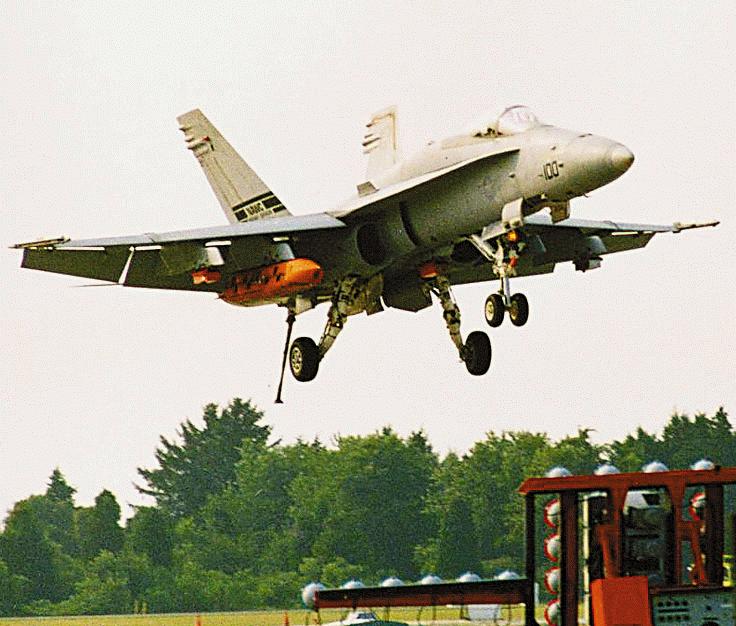
YLE reports that the Finnish air force is getting ground attack capability. They're buying 200 millions worth of kit off the US Navy including long range air to surface missiles. They've been trying to get this stuff for some years, there has been both reticence from the Americans to sell the best stuff and political resistance in the Parliament. I remember reading a minority dissent to a parliamentary defence committee report from a Left Alliance MP who specifically argued that the airforce is for defence and therefore didn't need ground attack capability. This is a bit of "duh!" arguement if you think about it, but reflects a general pacificist/neutralist strain that remains very strong in the Finnish body-politic.

Anyway, the Defence Forces will be pleased. Last year a prominent British analyst pointed out that Finland still has the biggest artillery force in Europe, 500 more big guns than the UK has. This was meant to be a criticism but tends to get a "yeah, and...?" response from Finnish defence professionals for what they take to be completely self evident reasons. Last year I put this 'criticism' to one of the most senior civil servants in the Ministry of Defence in Helsinki. He looked slightly shamefaced about it, a bit like a teenager caught wearing last years sneakers, but explained - "of course if we had long range air to surfaces weapons for the F-18s we wouldn't need so many". So dreams do come true (at least if you lobby hard enough), andGeorgia is on everyone's mind after last summer and that can't of hurt the MoD's case.

Wednesday, February 25, 2009

"The most dangerous place in the world"

Long time readers of this blog will know that I have an interest in Somalia. There is an excellent article explaining Somalia's recent history and current desperate situation by Jeffrey Gettleman of the NYT in this week's Foreign Policy magazine.

Print a copy off and read it during your coffee break. It's a fine example of clarity and approachability in dealing with a complex story that will give you a solid introduction to this sad country.

Wednesday, February 11, 2009

The Gaza-Egypt border

A screen grab of the Rafah crossing from Google Earth. The Philipdelphi corridor is visible as the obvious straight line (click for a bigger version).

Of all the dimensions to the Gaza war of last month, I've always thought that one that was worst reported was the Egyptian - Gaza border, and hence the Egyptian Palestinian relationship. I became interested in how the 14 kms of the border between Gaza and Egypt worked a couple of years ago when looking into how the blockade worked. I couldn't figure out how the Israelis could blockade Gaza when only controlling three of the four sides of the territories. Whilst Israel occupied Gaza, the IDF maintained a few hundred metres wide strip along the Gazan side of the border, the Philadelphi corridor, meaning that in effect they control all sides of Gaza, but it was handed to the Egyptians in 2005 during the settlement evacuation. I'm not certain, but I don't think the Egyptians ever patrolled on the Gaza side, instead letting the PA take control until the Hamas coup kicked them out. The EU had a mission - EUBAM (I can't help think of Bam Bam of Flintstones fame...) - which was meant to neutrally run the Rafah crossing, but they had to get there from Israel into Gaza and the Israelis would block them getting into Gaza at one of the other crossing points when they wanted Rafah closed. EUBAM were still twiddling their thumbs in Askelon, waiting for someone to tell them to go back to Rafah last time I looked.

So they Egyptians have just built a bloody great wall along the border with Gaza, hence all the tunnels underneath it. Anyway, File on Four on BBC Radio 4 have done a pretty good programme looking at Egypt's role in the Gaza crisis (download the podcast whilst you can). It doesn't cover everything, like political instability in the Sinai, but it's a very good primer. It also shows the hypocrisy of many of the Arab regimes - they allow at times strident, ugly anti-Israel rhetoric as a pressure valve on their oppressed domestic constituency who have no real democratic say, whilst actually do very little to help the Palestinians.

Wednesday, January 14, 2009

American guns in Mexico

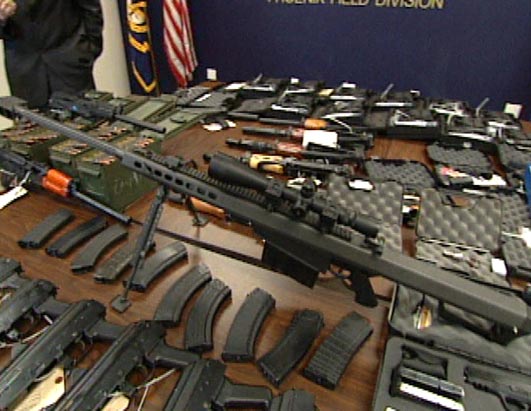
(Photo: ABC News) I reckon the drug war in Mexico was one of last years great non-stories in the media - always bubbling away in the background, some good journalism going on, but generally not getting huge attention. I had heard that most of the guns used by the criminals come from sales in the US, but I hadn't realised just in what huge amounts:
...the arms that cartels can and do buy from the open U.S. market -- completely illegally -- leave Mexico's police force and even its military outgunned. There are nearly 7,000 gun shops along the southern U.S. border, about three for every mile. They sell thousands of hand grenades, rocket-propelled grenade launchers, AK-47s, and "cop killer" guns and bullets that cut through Kevlar body armor. The weapons quickly flow south, again with barely a nod from U.S. Border Patrol.
Can I just run that by any American readers - you can buy hand grenades and RPGs in gun shops? That is definitely a "WTF?" moment. The quote above comes from a very interesting piece at Foreign Policy.com. See this ABC News story as well.

I've just had another thought - watch John Stewart
and fast forward to to 4.20.


Everyone is doing the "if missiles were being fired from (insert you neighbour here) into (insert your city here), wouldn't you respond?" The Israeli ambassador to Finland was saying this the other day for instance. It's a fair enough question - and maybe the answer is yes. But how does that look from the Mexican government's point of view? "If hand grenades and cop-killing high powered hand and machine guns were flowing into your country from suppliers across the border in your neighbour - wouldn't you respond?"

Tuesday, January 13, 2009

A not-about-Gaza post

I've been asked to blog something about Gaza for work, and I've wanted to say something about it here as well, but I haven't yet. It's all too fucking miserable to be honest. I think Hamas have shown themselves again to be zealots who don't care who gets killed - including their own kids - if it makes their bizarre point. I think the Israeli leadership has shown itself to be crass and willing to play politics with other people's lives. The IDF has shown itself ready to use massive force recklessly and then to lie about their civilian killing mistakes - even when they surely were just that, mistakes. Too many pro-Palestianian protestors around the world have turned out to be religious zealots who are surfing a new wave of religious anti-semitism or ridiculously cockeyed anarcho-leftist types who are all about teenage posturing and are in it for the ruck as much as anything else. And too many of the pro-Israeli voices are ridiculously screaming "I'm the victim here!" which just makes them look foolish to any disinterested observer as the IDF artillery pounds Gaza and F16s and Cobra attack choppers swoop overhead. Meanwhile the Israeli people get further away from ever being able to live without fear and the Palestinian people continue to get pissed on from a great height. I wish I didn't care and that most people didn't deserve better, but they do - both Israelis and Palestinians.

Anyway, my day was hugely improved upon when by mistake on Youtube I found this:

One can not loose all faith in mankind when somewhere in Tokyo there is a man who dresses up in an Imperial Stormtrooper costume and dances for apparently no reason at all. Tokyo Dance Trooper, I salute you.

Tuesday, May 20, 2008

More good blogs to visit

Bored of the same old blogs? A couple of suggestions for those interested in news and thoughts on the more depressing parts of the world. Firstly, The Stupidest Man on Earth - subtitle "on war and stuff". It's written by Jari, a very well travelled Finnish journalist, a real old school hack (and I mean that in the nice sense); he probably even has one of those khaki vest with about a hundred little pockets on them used by genuine foreign correspondents for some secret purpose not revealed to the general public.

Next is the [My]State Failure Blog, I found this by following a link from The Stupidest Man on earth, only to realise that I met the guy who writes it, Péter, at the conference I was at in Stockholm last week. Small world eh? Péter was, unsurprisingly, giving a paper on state failure. It is more theoretical than Jari's blog, so will appeal to the IR and political science types out there, but still written in an approachable way if you are in to that sort of thing.

But I'm sure you're not bored with this blog of course... and just to tease you, I'm debating whether to include in the weekly climbing post a picture from last weekend of a man doing a climb whilst wearing a pink tutu, fishnet stockings and fairy wings on his helmet. But I'm sure the serious-minded readers of this blog wouldn't be interested in something so silly?

Friday, August 31, 2007

Canadians in the Korean War

I post this purely because it amused me. I've been doing a bit of background research on the Canadian political debate over their presence currently in Afghanistan, but from time to time Google throws up something far more interesting than what you should be doing. This is a from a document about the experience of Canadian soldiers during the Korean War at the start of the 1950s. Life was pretty miserable, spending long periods of time in trenches in the freezing Korean winter:
The main meal of the day came at midnight, delivered in Dixies on the backs of Korean Service Corp soldiers. About three times a week the cooks dropped raw turkey legs into the boiling water in the Dixies and sent them to the front line. When they got to the soldiers, blood was still running from the legs. The cartons in which the turkey came were stamped "not for human consumption." Uneaten turkey was thrown into the barbed wire where the rats, much less fastidious than Canadian soldiers, feasted and multiplied.

Over the long nights the Chinese or North Koreans over loudspeaker from across no-man's-land frequently played sentimental songs. After a while a seductive female voice would say something like "American officers, American soldiers, this is not you war. Go home. A rich American capitalist is in Florida having turkey dinner with your wife, while you are in Korea freezing."

Asked how the propaganda affected him, one young soldier replied: "Not at all. First, I'm not American. Secondly, I'm not married. And thirdly, I don't want to eat any more damn turkey."

Tuesday, June 05, 2007

The social value of conscription

Conscription as integration? (photo from Helsingin Sanomat)

The seminar I attended last week was run by the Finnish National Defence University and was title "The Future of Armed Forces". There were some gradualist approaches to change put forward mainly by serving officers from various countries and some more radical approaches from the private and academic sectors. One speaker even suggested that in the modern world you don't really need armed forces, just a strong police and nuclear weapons - although his sentiment should be seen in the light of what happened forty years ago today: events that has left his country's military playing a quasi-policing role ever since and weakening them relative to their neighbours as a result.

But being in Finland, much discussion revolved around the value of conscription for modern armed forces. The Finnish defence establishment resolutely support the concept - at least in public - but I found the French experience far more convincing. If you want a modern, technologically advanced military, you need professionals, not kids doing six months before starting uni or college. France realised this after the first Gulf War where they had to sail their aircraft carrier to the Gulf with a skeleton crew after the president announced no conscript would be put in harms way, before promptly evacuating them from the ship as it headed south.

The argument is often put forward that conscription leads to social cohesion: Finnish President Halonen said exactly this yesterday at the Defence Forces parade through Helsinki, but reading her speech I had a wry smile remembering what I had heard from a French officer last week: "The French army decided that it was the job of the schools to make little Frenchmen not the military, our job is to kill people when the government tells us to."

Tuesday, April 03, 2007

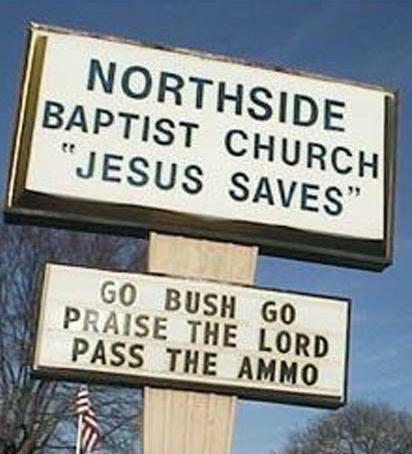
"Praise the Lord and pass the Ammunition"


A week without blogging. Sorry. I'm rubbish, but I am still here. Time just flies when you are stressed, tired and not having much fun. Anyway, enough of my moaning.

Over the last couple of years I've become a huge fan of Andy Kershaw's Radio 3 show. Perhaps I'm growing up if the one music show I listen to weekly is on Radio 3 - and quite clearly Tuareg desert music and acoustic English folk should be what all the cool kids are listening to, even if they aren't. Anyway over the last couple of weeks he has being playing tracks off a CD called: "Kickin' Hitler's Butt: Vintage Anti-Fascists Songs 1940-1944". What a collection. This weeks track was "Praise The Lord & Pass The Ammunition" by The Southern Sons Quartet. All wonderfully odd. Basically this reminded me of the photo above that I found some time ago and have been waiting for a good opportunity to share. Today seems as good a time as any as the Southern Sons Quartet show a good historical legacy to mixing American exceptionalism, blatant militarism and God. All good clean fun.

Wednesday, February 14, 2007

Shia-Sunni divide

The Sunni-Shia divide is becoming one of the most important issues driving international affairs today, but away from Muslim countries it's not well understood. The origins are theological but now it is more and more political. Anyway, NPR is doing a good series looking at both the politics and theology. There will be more radio reports put up today and tomorrow, but there is already plenty to read and listen to on their special pages for the series.

Monday, February 05, 2007

Bad Finland! No missiles!

I pinched the pic from Helsingin Sanomat, but they borrowed it from Lockheed Martin so its all free advertising for them in the end... If that is really a pic of the JASSM air-to-ground missiles concerned, it looks bloody big doesn't it? Presumably it is much nearer the camera than the F-16 otherwise I can't quite see how the Falcon got off the ground?

Anyways... so the US has refused to sell Finland a certain weapon and the Finnish press suggests that it's the result of poor bi-lateral relations as opposed to dozens of other perfectly possible reasons. There's an old joke about a Frenchman, an American and Finn meeting a elephant. The Frenchman looks at the elephant and thinks "look at zat fine leg! Wiz a lil' butter et garlic it will taste magnificent!" The American looks at the elephant and think "wow - an unclaimed elephant! What business opportunity. I'll do elephant shows and make a fast buck!" And the Finn looks at the elephant and thinks "I wonder what he thinks about me?"

Having said that I was told by a Finnish diplomat in Washington once what tactics they use to keep the Finnish foreign minister's more... ummm... expansive comments on the US off the top of the in-tray at the Finland desk at the State Department. But of course telling you that would just be scurrilous gossip and self-respecting bloggers never do that sort of thing!

Update: I just checked out JASSMs on FAS. For those of you who dig weapons-porn, knock yourselves out. ;-) Here's a pic of a Hornet carrying one:Unfortunately for Finland, that's not a Finnish air force Hornet!

Update 07 February: This is an interesting bit of news suggesting that bad bi-lateral relations are unlikely to be the reason for the refusal to sell Finland the missiles. Who knows really, but there are so many other possible reasons, and the Helsingin Sanomat story seems more like some good grist for the election time mill, as Finland approaches its general election. Thanks very much to the anonymous commenter who left the link.

How to make an IED - Lancastrians beware.

There is a small discussion underway attached to last night's post on the helicopter downings over the extent to which Iran is likely to be involved in these attacks. Alex, the Yorkshire Ranter, left a comment here at exactly the same time as I was reading his blog and came across his discussion from a couple of weeks back on how to build an IED with a shaped charge. I'm not sure if he has a military background or just spends more time than is healthy reading Jane's Defence Weekly, but he definitely seems to know a lot about these things - hence my warning to Lancastrians - after having lived a year in Leeds I'm pretty certain Yorkshire would fight dirty. ;-)

Basically whilst I'm quite happy to accept Iran is playing a major role in Iraq - if Russia occupied France, you don't think UK intelligence would be all over the shop from Calais to Marseilles? - but it seems that there isn't so much hard evidence of Iranian arms being used by Iraqis. KGS left this link in the comments, quoting an unnamed US officer saying that it was Iranian surface-to-air missiles (SAM) bringing down US aircraft. But read it carefully - that's not quite what the unnamed officer actually says is it? The direct quote is: "where else would they be coming from?" Well, out of the defeated Iraqi army's huge arsenal would be one logical possibility. And pushing this a bit further, KGS's link is quoting from another US mil-blogger - who simply wants an attack on Iran and he openly argues that the evidence to justify this isn't really important:
The affairs of state, of National Security, aren’t the purview of some twisted OJ Simpson celebrity trial, where “if the glove don’t fit, you must acquit!”
Let's leave aside all discussion on the morality of attacking Iran - perhaps a solid case could be made although it doesn't spring to mind at the moment - and consider the practical implications of this policy prescription. If the Iraqi insurgents of all stripes aren't relying on Iran for some, or any, of their weaponry - then the US isn't actually going to stop its helicopters from being shot down or APCs blown up by taking this drastic line of action. They will however make sure that Iran will do everything it can in the future to help arm anybody who wants to take shots at US's interests or those of its friends.

I think that a lot of the discussion amongst Democratic senators and congressmen (and increasing numbers of Republicans as well) in the US over bringing the troops home is more led by their political sensibilities to the domestic zeitgeist, rather than to any deeply thought out military and foreign policy strategy for Iraq. But I'm not sure if this sudden "get tough on Iraq" policy coming out of the White House isn't any different. Things are pretty terrible in Iraq and if you don't want to go with the 'Ricksian' Fiasco argument - that simply immensely bad planning and strategy within both the upper echelons of the US civilian and military leadership are to blame for where we are now - then it's really handy to have someone else to blame. And the Iranians fit the bill perfectly because the current Iranian government is so odious.

There is though a certain irony that US helicopters are only getting shot down over Iraq at all, because in 2003 we went with an evidential glove that didn't quite fit.

A quick update: KGS has just left some links in the comments of the previous helicopter post discussing Iranian weapons - I'll put them here so everyone can read them and draw their own conclusions. They are from the Guardian, the Telegraph, ABC and the Crisis Group. Thanks to KGS for digging them all out. The ABC is perhaps the most interesting one, but it still relies on unnamed officials promising that there is evidence. The Telegraph story notes that "there is no concrete evidence", and likewise the Guardian story points out they don't really know who the smugglers were. The Crisis Group write:
Even as accusations have proliferated, hard evidence has remained sparse. Typical statements, culled from Crisis Group interviews with government officials and political leaders in Iraq, include the following: "We received reports that [fill in the blank]"; "We have proof that [fill in the blank]"; "Everybody knows that [fill in the blank]"; "They spoke Persian"; "We have heard that Etelaat [Iranian intelligence] set up an office in Basra"; "Money is coming into the country"; "We have proof that Iranians are supplying Moqtada al-Sadr with money and weapons"; "We received a report a couple of weeks ago that Moqtada visited Falluja. This is clear proof of his cooperation with the insurgency there". And, in response to a direct request for evidence that the violent Kurdish group Ansar al-Islam has a presence in Diyala governorate and is supported by Iran: "You know, crossing the border is very easy". (p.3)
These links are all very similar to how the LA Times story linked above notes that the evidence of Iranian military support is discussed by coalition spokespeople but no direct evidence or photography is released. I'll say it again, I'm sure that the Iranians are busy in Iraq and may well be supplying weapons, but that doesn't mean that they hold the key to peace in Iraq or are responsible for all the US setbacks.

Sunday, February 04, 2007

Helicopter losses

There hasn't seemed to have been many obvious connections between what the British Army learned in its three-decade long counter-insurgency campaign in Northern Ireland and the situation in Iraq, but I do remember some years ago reading that what the British military feared most was the IRA getting ground to air missiles. In the rural areas near the border with Ireland, known as 'bandit country', land transport was never safe even for military forces, let alone the police, so the UK relied greatly on helicopters for resupplying border observation posts, to ferry troops around and the like. As far as I remember no British helicopter was ever shot down. The Soviets started losing in Afghanistan when the mujahideen began to be able to bring down their helicopter gunships as well, and it was tactics that were developed in Afghanistan that were used by the Somalia fighters who brought down the US Blackhawks in Mogadishu in 1993. So the news that the US has lost another helicopter to ground fire is very worrying, suggesting that insurgents are getting - and being able to deploy - heavier weapons and whilst the fighting gets worse - particularly in the light of yesterdays horrendous truck-bombing - it is going to be harder for the US forces to be able to move around to try and stop that violence.

Monday, January 29, 2007

Who cares about Somalia(?)

The title question-mark is in brackets as you can read this either as a question or, more likely, simply as a statement. The Economist does care and continues to cover Somalia more seriously than most media, but you could hear their correspondent's anger at the end of last week's report :
"It is a sad measure of the insouciance with which the world treats Somalia that it has managed to drop out of the headlines in the space of a week."
After a few weeks over Christmas when you couldn't move for Mogadishu news, we're back to a collective shrug of the shoulders. There were more US air-strikes last week that hardly got a mention, but seem to have been no more successful than the first round which, according to one US officer interviewed by the IHT, killed none of the leaders of the Islamic Courts Union, or the suspected al-Qaeda they were believed to be sheltering. Who the USAF did kill in the first strikes is not clear. The Ethiopians are starting to pull out (due to malaria of all things, according to the IHT), the Transitional Government doesn't have the power to really control Mogadishu, and ICU sympathetic-fighters are re-emerging to start fighting the government. The idea that the ICU had been "routed" always seemed rather fanciful as the ICU force was a conglomeration of localised militias rather than some unitary military entity. Hence it would seem logical that when the power of the Ethiopian military pushed against them they would just split back up into their original constituent parts. In that sense the Ethiopians did beat them completely but of course that doesn't take the danger away: just as the US has found in Iraq, you can make an army concede totally, but it doesn't mean that the people who made that army up, can't fight you successfully in tiny groupings later with guerilla tactics.

The African Union is still discussing sending peacekeepers but has massive financial, not to mention political constraints. Once the Ethiopians leave Somalia there is no reason to expect that the status quo of continually warring factions, with the Transitional Government once again just one of them, will not return - except for now there will be more anti-US and anti-western feeling after the air attacks and the US support for the Ethiopian invasion. No western country seems to be bothered enough to shovel money, let alone men or resources, to the AU to help out. So as the Washington Times correctly puts it: "the window of opportunity is apparently beginning to close."

Thursday, January 11, 2007

Somalia

Every day for about the last two weeks I've been thinking I should write something about Somalia, as it a subject that I have followed since starting this blog. But after having had to scrape around to read decent reporting and analysis on the country for most of last year, the current fighting has brought with it a veritable avalanche of attention to what was previously a rather marginal part of the world. Suddenly there has been almost too much news on Somalia to read and listen to.

For work I've followed US counter-terrorism operations in Africa for the last year and half quite closely. The US forces in Djibouti, CJTF-HOA, - where presumably the AC-130 that was trying to kill the al-Qaeda suspects (and probably failing) came from - have kept a much lower media profile than the smaller but more publicised Trans-Saharan Counter-Terrorism Initiative (TSCTI). My feeling has been that the CJTF-HOA has never really needed to justify its budget - it is run by CENTCOM, unlike the the TSCTI which is an EUCOM operation, and there are very few serious analysts of the region who dispute that its likely that the people who were responsible for bombing of the US embassies in Kenya and Tanzania had probably found refuge in Mogadishu, and were probably being sheltered by people who were in some way connected to the Islamic Courts Union. The TSCTI's claim to be helping to secure the Sahara against terrorists is much more tenuous.

But despite the ICU-al Qaeda link, coverage in the west that said the ICU was controlled by al-Qaeda, was just over-egging it to fit Somalia more neatly into the "War on Terrorism" discourse. It was clear even back at the start of last summer that the ICU was an unwieldy conglomeration of different interests, including differing clan loyalties. This probably accounts for its bad strategic decision making and its disintegration in the face of the Ethiopian advance. Yet disintegration is very far from being a rout, as the disintegration of the Iraqi Army in February 2003 so clearly shows. It would appear that many of the Islamist fighters "slipped away" taking off their uniforms if they ever had them in the first place and just going home. There have already been guerilla attacks on Ethiopian and Transition Federal Government (TFG) forces, and the Ethiopians are saying they want to leave soon, as they obviously see more of the same on the horizon and don't want their own mini-Iraq. This is causing American nervousness about a vacuum resulting; the TFG's forces are small and seem to comprise mainly of militiamen from the various factions currently behind the TFG, it is not clear that they could provide security without the support of the Ethiopian army.

The TFG is not starting off from a strong position. It has international support although the Arab League are whining. But within the country its seems that the population is yet to be convinced. In the last few days, I have read and heard two different Somali women saying that the Islamists had brought security to Mogadishu. This means the TFG - with African Union support (and that will need wider international support) - will have to rapidly make sure they can also provide human security to the population to the same degree or higher. This will test the resilience of the TFG, which is just as much an unwieldy coalition as the ICU was - but perhaps without the unifying ideology that religion provided the ICU. Yet the biggest hurdle for the TFG is that it is seen as a puppet of the Ethiopians and to some degree the US. This why the US air strike, particularly if the reports of civilians deaths whilst the targets escaped turn out to be true, was a bad idea. The AC-130 gunships seem rather blunt weapon, and the impression that it gives is that the US is indifferent to lives of uninvolved civilians, leaving aside all questions of sovereignty. As well as just further souring relations with the Muslim world generally, it clearly destabilise the TFG specifically in the eyes of Somalis by offending their nationalism. These points were being hammered home by guests on the NPR Dianne Rehm show yesterday, including Michael Scheuer - the former head of the CIA bin Laden unit.

That'll have to do for now, but I will return to this subject soon.