Monday, May 07, 2012

"Ice Moon" by Jan Costin Wagner

I've just finished reading "Ice Moon" by Jan Costin Wagner. I have this urge perhaps stemming from my PhD studies to read just about anything I can find about Finland written English. This used to be just out of interest or to gain more knowledge of the country, now as often as not it's to see what other non-Finns have to say about Finland. Wagner is a German married to a Finn, and the book is set in Finland with just a couple of marginal scenes in Sweden and Germany.

It is crime fiction I suppose, but it was first published in German in 2003 and then translated into English (by the superbly named John Brownjohn) and published in 2006 so that makes it relatively early in the whole 'Nordic noir' thing. It doesn't have much in common with some of the big hits I've read of Scandinavian crime writing; for me at least it was more engaging as a love story than as a detective story. Although in this respect it does fit into the traditional literary Nordic gloom as one half of the loving couple has just died. We observe the love of the novel's main protagonist in his grief for his recently deceased wife.

It is a very quiet book. The murderer is quiet, his victims die silently, the Finnish police say little to each other and the hero of the story is cut off from the world by his grief. I don't think they even mention any police cars turning their sirens on. The first snowfall of winter comes during the book making the world even more silent. I don't think anyone draws their gun at any point, don't expect action or violence. Perhaps this is realism for a Finnish crime novel.

The author's prose is sparse, he doesn't dwell too much on describing the settings either natural or man-made. Naantali, where much of the action takes place, is one of the more interesting small towns in Finland but there is little description of it in the text. I've read a couple of books by Camilla Läckberg set in Fjällbacka, in Bohuslän on Sweden's west coast. I found the books slightly annoying, but she does do a good job of describing Fjällbacka and its environs. Wagner doesn't do this for Naantali or Turku - indeed if you haven't visited them you won't have much of an image of them after finishing Ice Moon. A novel should not feel the need to be tourist information for the place in which it is set, so for me a bigger problem was that the story's timeline didn't make much sense. It starts in summer and ends in winter, but there only seems to be a week or two passing in between. The murder cases seems to play out relatively quickly - the first murder is still very much being actively investigated when the second and then the third happens. The events in the novel feel like they take place in a couple of weeks, but somehow it goes from midsummer to the lakes being frozen enough to walk on. I've longed toyed with the idea of writing a novel set in Finland - 'write about what you know' and all that - and always felt that the passings of the seasons and how nature changes would be the backdrop to a story of people. I think that is what Wagner has tried but he seems to have set two different clocks that are running at very different speeds. More than a detective novel, Ice Moon is a character study and it feels a little too much like the changing seasons are just being used as a literary device to amplify this.

One other minor criticism also occurred to me, although it is only likely to be of interest to Finns or those who have made some attempt at learning Finnish; the main character's name: Joentaa. It sounded odd to me and I asked my wife, she said she it doesn't really mean anything and she's never heard it as a surname. A quick look on Finnish Google supports this, with nothing coming up except references to this book. Perhaps the author picked a surname that sounds Finnish but isn't really on purpose as it is an odd mistake to make when all the other names sound real.


Sunday, May 06, 2012

Kill your television

I like Finland more than I claim; don't tell anyone - it might damage my image as moaning, snarky foreigner. But a constant source of both amusement and irritation is how Finland presents itself to the world and wishes to be perceived by the world. There is the "Finland" of tourist info office, of the tweets of Alex Stubb, Minister for European Affairs and Foreign Trade, and indeed of many proud Finns when they tell foreigners about their country. Then there is the Finland in which I live. Sometimes the two line up, at other times they don't. 

This many TVs - presumably commercial waste rather than domestic?
The last snow melted in the shady corner of my garden last week, and I swam in a lake on Vappu (Mayday) eve that I was told had ice still floating in it three days earlier (not hard to believe once you got in). As the snow melts but before the vegetation grows it's hard not notice the strange fruit that line the roadsides. The tourist info will tell you of "unspoilt forests" and how important those dark woods are to the Finnish people. I'm sure this is all true, although it doesn't seem to stop many Finns throwing their unwanted shit into those now slightly less unspoilt forests.

Builder's waste, or just a thorough spring clean of someone's house?
 Of course douchebaggery knows no borders, but fly tipping and other forms of disgusting littering are a big enough problem in Finland that it riles me every time I hear people mentioning a generic national love of nature or those unspoilt forests.

And for anyone who didn't get the title, shame on you for your insufficient knowledge of the early 90s British indie scene. Grungey Americans, don't forget - the Grebos of Stourbridge beat you to it. ;)

Wednesday, April 11, 2012

The People's Mujahedin of Iran and their friends in the west

The BBC World Service has a remarkable documentary available currently on the People's Mujahedin of Iran (PMOI). Most non-Iranians will have not heard of the group, but in short they were anti-the Shah and supported the revolution against him - it's important to remember that it's only really subsequently become labelled the 'Islamic Revolution'. At the time there was a considerable radical left-wing and secular dimension to the uprising alongside the later to be dominant Islamists. The Islamists under Khomeini subsequently turned on their previous leftist allies, including the PMOI, and the group went into exile in Iraq where they allied with Saddam Hussein against the regime in Tehran. The documentary does a pretty good job of explaining the general weirdness of the group, leaving aside their politics. It would appear to resemble a cult more than a political party now, with at least hard to dismiss claims of mistreating its members who wish to leave.

Nevertheless the most noteworthy dimension to the documentary is the reporting on the PMOI's lobbying within the United States. The group was listed as a terrorist organisation in the 1990s by the US government and remains so to today. In Europe it has been de-listed as a terrorist group, although its fund raising within Europe appears to be dubious to say the least. The BBC interviews numerous prominent Americans who are now part of the PMOI's campaign in the States to be taken off the terrorist group list; they include Republicans and Democrats, and many former senior officials and soldiers. It gives a fascinating insight into this world: some of those interviewed openly admit to not knowing anything about the PMOI before being approached to speak at their events in return for (considerable) payment. Nevertheless, these personalities seems to have taken their duties seriously and are openly pushing for the PMOI to be brought in from the cold - believing clearly that their position against the current regime in Iran* means their past sins (including involvement in the hostage taking of the American diplomats in Iran all those years ago) can be forgiven.

Perhaps the enthusiastic cynicism of some in the American political world should be no surprise to us, but it's always interesting to see how this sort of lobbying for non-domestic interests works. What is far more alarming is listening to the non-mercenary supporter of the PMOI - a former US colonel who dealt with them in Iraq when the US took over their camp there - who seems to be seriously suggesting that this exile group, who have not been in Iran for nearly 30 years and that has its own cultish leanings, could be the core of a future Iranian regime when the current leaders in Tehran fall or are deposed. I expect I'm not the only one for whom, on hearing this, the name Ahmed Chalabi immediately springs to mind. People really don't learn from their mistakes do they?

*Incidentally, some reporting links the assassinations of Iranian nuclear scientists to Israel via the PMOI. This has a certain attractive logic to it - if Israel is behind the assassinations as seems likely presumably they would need some sort of proxy in Iran, plus the PMOI has been responsible for bring to light some of Iran's secret nuclear facilities. Nevertheless, the PMOI has denied any linkages to Israel, there is little hard evidence linking Israel to the attacks so far, and the PMOI are far from being the only Iranian domestic insurgents/terrorist groups - there Baluch and Arab separatist groups in Iran for example as well.

Wednesday, March 28, 2012

When cities die

Years ago, I was reading the ice climber Will Gadd's blog. Will had a post linking to photos of Detroit where nature was reclaiming parts of the city where people had basically left. I was so impressed by the photos I wrote a brief post myself linking to the same material. That was in 2007; since then I think the emptiness and devastation of parts of Detroit has become quite well known. I've even seen it used as a back story on some cop show where one of the "urban explorer" got bumped off for reasons I no longer recall. I remember hearing that some in Detroit are really quite annoyed now about the stream of journos and photographers who arrive from around the world to see the 'ruins' of a city where I suppose many hundreds of thousands do still live.

Anyway, today's Slate Culture Gabfest discussed a recent piece in the NYT Magazine called "Jungleland" on what's left of the 'Lower Ninth' in New Orleans. Slate hadn't got all their links up when I first checked out their show page, so I just went to Google Earth to get some idea of where the Lower Ninth is and looks like (I've never been to New Orleans). On the satellite imagery things look quite normal from some way above: lots of houses are visible, some parks etc. It just looks like many other spacious spread out American suburbs. But going to Google Maps and using Streetview, the desolation of the area is starkly apparent. Many of those roofs visible from above are on abandoned and derelict houses. Some people have rebuilt and are living there, but most of the houses were simply washed away, some of the inhabitants with them, and there's just scrub and rubbish left behind.
View Larger Map This is 2403 Flood Street, I've chosen it completely by random after clicking up and down various roads in the district. Spin around using streetview and you'll see the one little white house there, shiny and new with what looks like a wheelchair ramp outside, and then its surrounded by something that is going back towards wilderness, but as the Slate discussion revealed - its not even 'natural' wilderness, as the area is becoming dominated by mono-cultures of invasive species.

It is one of the saddest things I've ever seen.

Saturday, March 10, 2012

Ice climbing links of interest and some housekeeping

A little housekeeping, and then some "links of interest" (obviously if you aren't interested in the same things that I'm interested in, they will be links of un-interest - so sorry in advance about that).  Firstly, I was told by a certain lightweight backpacking evangelist and all round tech dude, that I would look much cooler if I installed Disqus as my blog's commenting tool. Always wanting to burnish my hipster credentials, but otherwise non the wiser as to why it is a good idea, this I have now done. Disqus also claims that it is importing all previous comments into the new system but this will take some time. So far it hasn't and I am in state of nervous apprehension as to where all my comments have gone from the last six years. I haven't gone through the trauma of dozens of flame wars and being called a terrorist-lover, Islamophobe, anti-Semite, Zionist, shit climber and bore just to lose all the hard-earned abuse in technical glitch I hope! And that certain UL evangelist better realise that his toilet paper teepee (132.4 grams) and home-made clingfilm rain trousers (52.1 grams) will do nothing to protect him from the wrath of an infuriated mediocre ice climber/international politics blogger should Disqus lose all my comments! :-) Anyway, if you're bored, do leave a comment with some fresh abuse, or just to say hi, and lets see how this clever ole' disqus business works.

It's raining now outside but despite this, we plan to go climbing tomorrow. Yes this is probably a silly, or at least soggy plan, but we shall see. On an ice climbing front, I was dead chuffed to have an article published on Finnish ice climbing in Climb magazine in the UK. Ian and Dave at Climb made my article look great and I hope folk enjoy reading it.

Screen shot of my Climb article
I was very aware in the article that I didn't really discuss the best place for ice climbing in Finland, Korouoma, mainly because I have only been there once and it is a long, long way away. But having seen the following video of climbing there (thanks to Max on Facebook for highlighting the video), I really have to get back up there.


Congrats to all involved for making such a great little film of the place.

Finally, Nick and Jim, who we stayed with for a few days whilst ice climbing in Northern Norway this time last year, are back up there. This year Nick as well as Jim is blogging. It looks like they haven't had fantastic luck with the weather this year, but still have been doing some really impressive climbing. Neither Nick nor Jim are your sponsored super-hero types, they are just weekend warriors like the rest of us, but I have huge respect for them for just getting organised and turning up. Ice climbing somewhere like Arctic Norway need some faith, a sense of adventure, solid mountain sense and, to borrow a good Finnish word for this, sisu. It's people like Nick and Jim that make the climbing community great. It's easy to get cynical when you follow the commercial interests, competition for recognition, back-biting and petty tribalism that are also part of the climbing community, but all around the world there are people out there on cliffs and mountains just like Nick and Jim, just doing it for fun (even when it is anything but). So enjoy the rest of your holiday chaps! May the skies be blue, the ice solid and plastic, the winds still and snowpack stable. Take care and have fun.

Tuesday, February 28, 2012

Winter 2012, the story so far.

A cold walk home in January.
Last week we had the first thaw since the cold set in at the start of January. Suddenly the world is full of the sounds of drip, drip, dripping, the birds sing and there are intermittent crashes as roofs shed their loads of snow; full depth avalanches in miniature, lubricated by the newly released water below the pack. Soon the temperatures dipped back below freezing, and fresh snow covered the slightly grubby piles of heavy ploughed snow, but the thaw is a reminder that the calender slips quietly by and somewhere ahead spring awaits.
Nuuksionpää - early Jan. So desperate we will climb in the rain.
This pause from the frost seems as good a place as any to round up some photos of winter climbing so far this year. Life has meant that I've mainly been restricted to local venues on the whole, but at least I'm lucky enough to be an ice climber with local venues, and it means after a bad start to the season I have been able to get a few things done.
The first Kenyan ascent of the mighty North Face of Kauhala? Kenedy's first go ice climbing.
After the last couple of good, long, snowy, cold winters we were maybe getting a bit blasé; expecting to start winter climbing in early December and going on until late March. The start of this winter swiftly disabused Finnish ice climbers of this expectation. Indeed winter never seemed to start; the cold, wet, grey, soggy days of autumn just got shorter and shorter, the nights longer, but temperatures simply refused to dip below freezing. I had the great fortune to leave Finland for all of the Christmas and New Year period for that 'Great South Land' where it was midsummer and the only sensible option for Xmas lunch is a picnic at the beach. When I got home in early January there was still virtually no snow but almost in time with our arrival back, the mercury plummeted, some snow fell and things started to look up.
Jody, trying not to do himself an injury à cheval on the horrible 'bridge' to Muurla.
 My first trip out was to a local cliff where there is a mixed line I have been failing to get up down the years. No one else could make it that day, so I shunted the line on a toprope. It went surprisingly easily and cleanly, completely lulling me into a false sense of security for later attempts.
Steep conditons at Muurla, early season.
Other trips followed, ice climbing in the rain at Nuuksionpää, ice at Muurla, mixed climbing at a new crag called Rajakallio, back to Crag X to fall off my project with hands frozen from trying to fiddle with rock gear in thin gloves at -17. Against my better judgement, Eärendel persuaded me out for an afternoon at Nuuksio when the temperatures were the wrong side of -20. Somehow it went suprisingly well and I got an excellent reviewing opportunity in that cold for a belay jacket I'm testing for UKC.
A brutal mixed struggle at Muurla
It has been a cold period, and cold toes and fingers seem to have been something of a theme over the last month and a half.
Narrow but better angled ice at Muurla.
I've had the pleasure of climbing with some new people, and some new places which is always good. Climbing with Joel, Henkka and Miko at Rajakallio was both of those, and turned out to be a fantastic if chilly day. For me the day was capped off by Miko and Henkka pointing me towards an unclimbed chimney line, not a hugely common thing on Finnish crags and telling me and Joel to give it go.

It was a good fight, as these things should be, but I managed to lead it, so Joel and I get the probable first ascent of this really cool line.
A cold night at Airport Crag.
A week or so after than I finally got up my Crag X project. I found it a real struggle on the day, but it was actually rewarding that the route that day was in almost 'Scottish condition', frozen veg, plenty of snow, even some fine, rare frost on it. Much more fun than just drytooling. I ached for ages afterwards, but it's worth the ibuprofen bill.
The promise of sunrise - first visit to Rajakallio
So, over all, not too bad a start to winter, and hopefully the spring thaw won't arrive just yet. Enjoy the rest of the photos.

Joel topping out

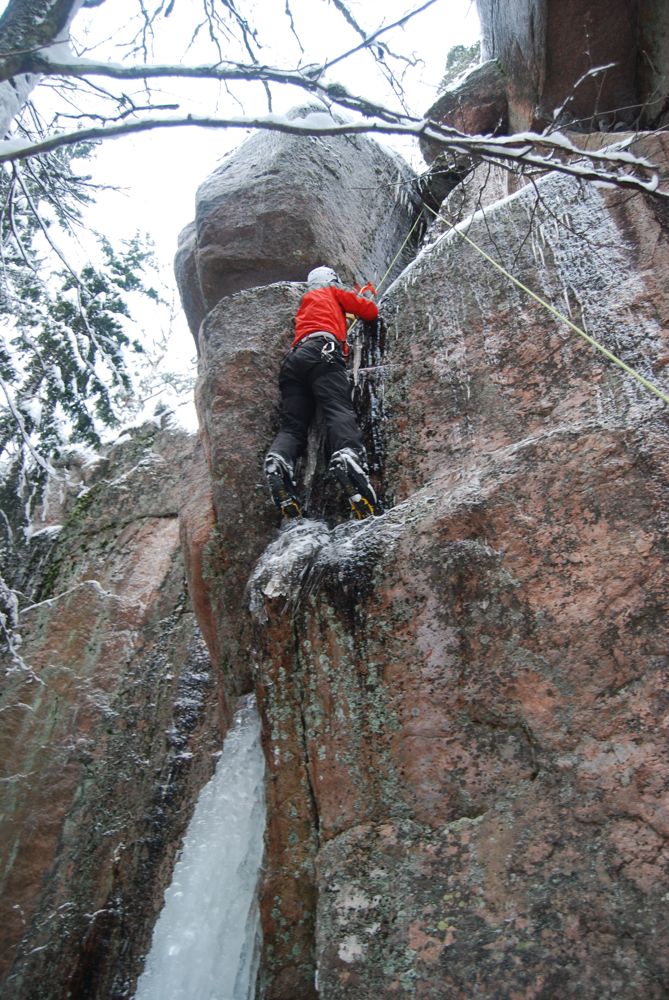
Me on the probable FA of "Apollo's Angels" (M4-ish?), Rajakallio.

'Modeling' for the UKC review of the Marmot Zion jacket ;-)

Henkka suggests "the three stooges" for this one. His two fellow stooges may beg to differ.

Joel on a fat "Where the Wild Things Are", Crag X, Nurmijärvi.

Lots of easy ice at the left end of Jaanankallio.

Sun through a haze of ice.

Cold Snow.

Vasen Suora at Nuuksio in excellent conditions.

Eärendel leads Oikea Suora in tricky conditions and 22 degrees of frost.

On the way back to Crag X for another go at the 'proj'.

The project finally goes with no falls or rests - hurrah!

Tuesday, November 01, 2011

Reading Orwell in (north)eastern Europe.

I don’t know why but I decided to read George Orwell's The Road to Wigan Pier. Besides a few of his shorter essays, I guess I haven’t read any of his books since school. Anyway the following paragraph jumped out.
I am not a manual labourer and please God I never shall be one, but there are some kinds of manual work that I could do if I had to. At pitch I could be a tolerable road-sweeper or an inefficient gardener or even a tenth-rate farm hand. But by no conceivable amount of effort training could I become a coal-miner, the work would kill me in a few weeks.
He clearly holds the miners in awe but is also perhaps being somewhat modest. An odd thought struck me about how lucky Orwell was to be born British considering when he was born. Perhaps because I have read some excellent books this year that deal with the terror of Stalin’s rule (most notably “Bloodlands” by Timothy Snyder and, in fiction, Sofi Okasanen’s “Purge”) it crossed my mind that had Orwell been born in what became the Soviet Union, or indeed in many other places between Berlin and Moscow, he may well have had an opportunity to find out how correct his premonition was.

Saturday, October 15, 2011

"No, not him": the new Tiitinen list.

Of course throughout the Cold War, Finland could never admit that there was a Cold War. That was something the nasty superpowers did; studiously ignored or denied up in the north where neutrality supposedly meant good relations with all. Those who were involved in the Finnish end of that conflict (or who looked on from the sidelines) are still very much with us. They fill the upper echelons of political, economic, media and cultural life in the country, and whilst things stay that way, stories around the Tiitinen list aren't going away.  Until the list is made public, or another generation or two retire and die, the story will hang around Helsinki political circles like a bad smell.

But this week saw the publication of Alpo Rusi's book about the list - the book being the result of his legal battle to refute the story that his name was on the list. Rusi announced that a former Finnish prime minister (now deceased), Kalevi Sorsa, was on the list. This was one of the first bits of political gossip I heard when I started working as a researcher, on the outer fringes of the Helsinki political life, a decade ago. I had always presumed that if a fresh-off-the-boat foreigner had heard such a thing it was one of those open secrets that most had heard but no media would publish. Now Tiitinen (previously the head of the Security Police, now Secretary General of the Parliament) has denied that the former-PM was on the list. This must be a great thing for Sorsa's friends and family - in effect exonerating him, but an odd way to go about things.

Can we expect journalists now to suggest names to the secretary general every time they corner him in the corridors of the Eduskunta (parliament) in order to collect his denials? Perhaps they should start with the President, every current government minister over the age 40, the heads of the ministries of state and perhaps the editors-in-chief of the biggest papers and TV channels. If Sec. Gen. Tiitinen denies that those people are on the list, the next journo can try the ministers and prime ministers of the last few governments.

Alternatively, they could just publish the list, end the rumours and let people make peace with the past.