Showing posts with label cycling. Show all posts

Wednesday, July 29, 2015

Bikepacking around the Peak District


Since moving to Sheffield nearly a year ago I’ve been getting out into the Peak District and beyond quite a lot, but this has been mainly focused on climbing. I’ve ridden a lot for commuting during the week, keeping my cycling legs ‘in’ that way, but have had few opportunities for riding for pleasure. So now having finished my course, and having some time, I decided to get out and explore the Peak by bike. I didn’t want to ride on roads but I sold my trusty old mountain bike as part of our massive ‘life-streamlining’ before we moved from Helsinki. Hence I was going to need to find a route that I could do on my cyclocross bike as besides my roadie, that was the tool to hand.

On the trail in the White Peak.

Cromford Mill - first sparks
 of the industrial revolution.
There is definite sweet spot for off-road riding on a cyclocross bike (CX). Too smooth and you might as well be road biking on a lighter, faster bike. Too rocky and technical and it just feels like your teeth are going to rattle out of your head and you just want a mountain bike with suspension. In England and Wales the law helps define that sweet spot though; bikes have no right of way on footpaths, you are only allowed to ride on bridleways. In many parts of the country, bridleways are often farm tracks – they can be rough or muddy but in rural areas they usually are drivable for a Landrover or a tractor and the determined CX rider. The route I took followed bridleways throughout, so I was fully 'legal', although much of it made use of more modern cycle routes using old, dismantled railways lines - thanks to the brilliant Sustrans organisation that is creating a network of long distance routes across the UK for non-motorised traffic.

I started south of Chesterfield in the town of Clay Cross - my wife had to go that way for work that morning so it got me quickly away from Sheffield and towards some unfamiliar terrain. After the first 15 kms or so on quiet country lanes I dropped down into the Derwent valley just south of Matlock. Crossing the river and the Cromford Canal at High Peak Junction you get onto the High Peak Trail, and old railway line and now a national cycle route. You generally think of railways as being flat or nearly so, which makes dismantled ones such great cycle routes, but this is not the case here! The 19th century engineers needed to include massive inclines to get the railway up out of the river valley. Static locomotives were used to help trains haul or lower their loads up or down these inclines. They are not so steep as to be impossible to ride, but they are quite unlike road climbs for the cyclist: arrow straight and of a completely consistent angle, there is really nowhere to hide and no brief easings of angle as you toil up them.

Above the inclines.
On to the Pennine Bridleway.
The inclines take you up above the Matlock valley where you can see numerous quarries, abandoned and still working, and factories and their chimneys - again both empty and still in use. It is a lovely, verdant valley but it set a theme that is ever present in the Peak District: although now a rural area of great beauty, there are signs of past industry everywhere. It's strange but as the economy has changed so much in the post-war period, large parts of Britain have in effect been "re-wilded", or at least "re-ruralfied". Places which were once alive with the industry of both workers and their capitalist bosses; places of production, social conflict and social progress have slipped back into being rural backwaters where once again agriculture is the main industry. It is now the turn of people in the Far East and the Global South to go through those huge social and economic changes that took place in the valleys of the Peak District 18th and 19th centuries.

Once out into the open countryside of the Southern Peak, the High Peak trail allows rapid smooth riding westwards through limestone country. Limestone is not my favourite rock for climbing on, but it does mean wonderful wild flowers. The cuttings and banks of the railway line were alive with yellows, blues, pinks, purples and more, and buzzing with insect life. Occasionally I could see beautiful Common Orchids growing. The wildlife might not be as exciting as you might see in Finland, but the odd deer, rabbit and voles came into view and hovering kestrels were ever present. The High Peak trail above the inclines also includes the starting point of the Pennine Bridleway - a newish long distance path that will take the mountain biker or horse rider all the way to Scotland if they wish, roughly paralleling its older and better known sibling, the Pennine Way. I would follow the Pennine Bridleway until lunch time on the second day, when I would swing back east towards Sheffield on the Trans-Pennine Trail.

When the High Peak Trail merges with the Tissington Trail at Parsley Hay station, it swings northwards. The station is now a bike hire place, National Park info office and cafe - the coffee and chocolate tiffin is to be recommended.

New and old industry
above Cheedale.
Perhaps 10 kms north of Parsley Hay the disused railway meets still used rails, so just before this the trail, now solely the Pennine Bridleway, leaves the cuttings and embankments of the ex-railway and follows quiet lanes and farm tracks before dropping dramatically (read: really quite exciting on CX) into the amazing limestone gorge of Cheedale. Cheedale is again a place of old industry now going backwards to rural backwater. That industry left another old railway route through tunnels and over bridges down the gorge, which now makes the lovely bike and walking route, the Monsal Trail. Modernity now comes to Cheedale in the form of some of the hardest sports climbs in the UK on the various limestone walls. But the my route just crossed the Monsal Trail and the river, going north straight up and out of the dale via a beautiful but very steep meadow - the first place I had needed to get off and push.

North of Cheedale was some of what felt like the least travelled parts of the route that I followed. For a few kms the trail felt more like a footpath than bridleway but, on the other hand, despite needing to crash through vegetation nearly choking the path in places (fortunately not too many nettles!) it gave some really good singletrack riding in places.

The limestone gorge of Cheedale.
There is a trail there somewhere!

First push, out of Cheedale.
Traversing Mount Famine.
The Peak District is made up of two quite distinct visible geologies - the White Peak, the limestone predominantly in the south, and the Dark Peak, the gritstone to the north. By now with the afternoon pressing on, the route followed quiet lanes and started to climb towards the dark bulk of the Kinder plateau. At some point a line is crossed and the drystone walls are now made of the brown grit and not the white and greys of limestone. Crossing the high road between Chapel-en-le-Frith and Castleton marks a sudden change in the feel of the trail; the next section that traverses the western flanks of Kinder at over 400 mtrs of height is really mountain-bike country.

I didn't have a mountain bike, although I like to think I impressed the the passing MTBers with my doggedness (they were probably laughing at... not with...!). The Pennine Bridleway is an impressive path at this point but it is tough technical riding in parts as you traverse towards the wonderfully named Mount Famine, a spur coming down from Kinder. I pushed more here than anywhere else on the ride, but I guess I still managed to ride 70 percent of this section. The descent down into the village of Hayfield was excellent fun, although I suspect would have been even more fun with wide bars, hydraulic brakes and 140 mms of suspension up front!
Into the Dark Peak, tough going on the flanks of Kinder.
Looking back to Hayfield and Mount Famine.
Hayfield is lovely, I had a pie and pint in the pub, stocked up on supplies from a shop and left the town following the trail very steeply up onto Lantern Pike. Once the local boisterously good-natured Scout troop that had hiked up there left, I was all alone at the top so it seemed as good a spot as any to quietly put up my tarp and camp for the night. The views of the sun setting over Manchester to the west and lighting up the slopes of Kinder to the east were exactly the type of thing that makes wild camping worth it, even in a country where it is not exactly legal.

Evening light on Kinder, with Kinder Downfall just visible.
Sunset over Manchester and the Irish Sea.
Breakfast in bed.
I woke up in wee small hours hearing rain on the tarp, but I stayed dry and warm under it and the morning dawned blue and cloudless. Following the Pennine Bridleway over some more hills and then plunging down towards Glossop was good riding. In Glossop, I finally left that route when it is crossed by the Trans-Pennine Trail (TPT). This long distance route goes from the Irish sea near Liverpool to North Sea at Hull, but I was about to follow it to its highest point as I crossed back from the west to the eastside of the Pennines. The route up Longdendale follows old railway track again so its very straight and smooth. The path leaves the old track where the rails used to go into the now closed Woodhead tunnel. The TPT instead crosses the busy A628 (it is busy with lots of big trucks - take care!) and goes steeply up a hillside (more pushing) before following a rough bridleway up to the top of pass. The Woodhead Pass is high and quite wild in a way, but definitely not "wilderness": a busy road goes over it, Longdendale has big pylons carrying electricity cables that then go under the pass using the old railway tunnel. There are also reservoirs and dams in the valley bottom. But looking up to the cloughs and crags on the northern edge of Bleaklow you can see the wild country.

Getting going on day 2. 
Rough tracks giving slower but fun riding.
Looking toward Manchester - I can see my old uni!
Across the Woodhead pass and back in Yorkshire, the TPT plunges down into the Upper Don Valley and picks up the old railway line where it emerges from the eastern end of the Woodhead Tunnels. It’s then old railway - flat, straight and fast -through Pennistone, Deepcar and taking you almost all the way back into Sheffield. Once back in city centre there just one more steep hill to slog up and I was home in time to go and pick the kids up from school.


Climbing out of Longdendale - the Woodhead tunnel is somewhere deep below my tyres.
Traffic jam on the Trans-Pennine Way.
Back into Yorkshire, all downhill now.
Overall I did 151 kms in two days, of which probably only 25 kms was on paved road, arriving home sweaty, dirty and (perhaps unusually for Northern England) dry but slightly sunburnt.

Snapshot from Strava showing the route and profile - day 1:


Snapshot from Strava showing the route and profile - day 2:


Sunday, December 08, 2013

An early winter bikepack


It seems that a late November weekend scout camp is now part of my kids's annual schedule, so a couple of Fridays back I found myself back up in the Forssa area, about 100 kms northwest of Helsinki with 36 hours to kill. It was mid-evening, slightly below freezing and very very dark. Last year I had taken my mountain bike and tried bikepacking the hiking route, the Lynx Route/Ilvesreitti, with limited success. The 'trail' was marked by waymarks but not enough people had actually walked it to make much of trail on the ground. I did a lot of pushing and carrying the bike through forest brush. This year I decided to stick to roads and forest tracks, including riding sections of the long distance bike route the Häme OxRoad/Hämeen Härkätie, that goes from Turku to Hämeenlinna, so took my cyclocross bike. A lot of the roads and trails are unsurfaced so the CX was a great choice, I could nip along paved sections at a decent pace, but had plenty of grip on the gravel.


Last year it was grey and just above freezing for the whole trip, and in November in Finland the days are so short and the sun always so low that it brings a whole new drab meaning to “grey”. This year I lucked out and the sky cleared early on Saturday morning and stayed clear until after I was asleep that evening, the temperature never got above 1 degree and was often just below freezing according to the thermometer on my excellent newish bike computer.
Saari Folk Park
The Saari viewing tower
I camped in a carpark in LiesjärviNational Park on Friday night with the luxury of a tent and left the car (and tent) there on Saturday morning. That day I rode a bit over 90 kms; this included some hiking single track in the Saari Folk Park but mostly was on unsurfaced roads and forest tracks. A good day of gravel grinding. It didn't feel that big a day but I ran out of daylight and had to ride the last hour or so with lights on to get to the laavu (lean-to shelter) I had decided to use that night. This was actually the same one as I had camped in last year, but it was much nicer this time with all the stars out above and no wind.

I lit a fire in the fireplace with out much trouble, although it never really got to that pleasantly roaring stage. There was only the dregs of the woodpile left, I guess after a summer of visitors, and although the logs burnt they didn't seem to put out much heat. I made lots of hot drinks to rehydrate – it's easy to not drink enough riding in cold weather – and ate my dubious far-eastern pot noddle thingy for supper, but with an indifferent fire retired to my sleeping bag very early.


Sunday morning, I didn't have much time before needing to go and pick my son up from scout camp so got up early, made some hot drinks with breakfast and packed up. It was still only getting light as I left the laavu and the moon was shining brightly over the lake. I only needed to ride about 20 kms back to my car that morning. It had snowed over nigh; enough to make most of the world white but not enough to bother me in terms of riding. My new tyres seemed to grip through the snow perfectly well and reasonably soon I was back where I had started and putting the bike back on the car.


Overall, the Häme Lake Uplands area is nice region to ride and the available map designed for hikers andother outdoors user is a great resourse. The roads away from a couple of highways, that I only crossed, are almost deserted. I reckon only around a dozen cars went past me all day. At this time of year in particular though, it is rather lonely – even though there are national parks with the related infrastructure you might expect, everything was closed. I found one cafe in the post office in Porras open, where I had a lovely chat with the ladies picking up their parcels and having coffee (I suspect and Englishman on a bike speaking very bad Finnish might have been one of the more novel events of their day), but beyond that I went past no open shop, cafe or similar. Make sure you have enough food with you. There are also large numbers of abandoned and decaying buildings in the area, barns and old farm houses like this are quite normal in rural Finland, but the empty petrol station and shops (see photos above) had an unnerving feeling of looking a bit too much like a scene from "The Walking Dead".

Of course you can camp pretty much anywhere, but I pushed on to get to a laavu I used last year – knowing it was great spot and has a fireplace, wood and a compost loo. But because of the hiking, riding, canoeing and cycling routes around that area there are quite a few similar laavus around.


I had new tyres for the trip, SchwalbeMarathon Plus Tours. I was still using my original Marathon Pluses through this summer on that bike. They came on my last bike and have been absolutely superb. I must have done at least 10,000 kms over five years on them and have never had a puncture but they're showing their age with the sidewalls beginning to crack and the tread must be wearing somewhat even if it doesn't look like it. I've ridden a few cyclocross races this autumn and using my light CX tyres and have had a puncture in one race then a double puncture in the next – all pinch flats from hitting rocks and having the tyres blown up firm doesn't seem to help. Hence deciding to try the Marathon Plus Tours – the same hopefully bombproof construction as the normal Marathon Plus, but with a bit of tread that seemed more suited for gravel roads and forest tracks of Finland. On this trip they were great – the grip felt great, even on Sunday morning riding back on snow. The only downer is that with those very meat tyres plus mudguards on, the bike felt bloody heavy. I'm not sure if serious CXers would want to race on them, although for me if they didn't puncture it would offset any slowness caused by their weight. For touring like this though they seem perfect, hopefully I'll get 10,000 trouble free kilometres out of this pair.


For cold weather bikepacking you need a bit more gear just to keep warm. I used the same set up as in September with my new Alpkit bikepacking bags and lashed-on dry bags but also took a waist pack; just that bit more capacity than I needed in summer. One of those bigger things for winter is the excellent Jöttnar Fjörm down jacket that I'm reviewing for UKClimbing currently. It's very warm and a nice “insurance” layer to have, obviously designed as an belay jacket for ice climbing but works great for any cold weather camping. It was stuffed with my sleeping bag in the dry bag that goes under saddle. This is fine when riding, but I need a number of straps to hold it in place which makes getting things out of the bag a hassle if you're not stopping for long. The obvious if a bit expensive solution to this is to buy one of Alpkit'sKoala seat packs, meaning retrieving a jacket from the seat pack would be easy, but I'm not convinced the Koala packs would fit as much as my current arrangement despite supposedly being the same size as my current dry bag I use there. Nevertheless, I know from winter climbing that your belay jacket HAS to be easy to reach because otherwise there is the temptation not to use it with the inevitable downwards circle into shivering. I guess with cold weather bike touring the situation is not dissimilar so I need to work this one out.

Thursday, September 19, 2013

Bikepacking - new bags, new camera.

Autumn is here and the sky is full of skeins of geese
So far all my attempts at bikepacking have been made with gear that on the whole I already had. I did buy a cheap bar bag that worked well but it won't fit the wider bars of my cyclocross bike. I also bought a seatpost rack, but that snapped on my last trip. Mainly I've just lashed dry bags to various parts of the bike. But with the bikepacking idea taking off in the UK as well as elsewhere, the British firm Alpkit (who I've written about in the past) are now offering custom frame-bags and are bringing out additional bikepacking luggage. I invested in the Stingray frame-bag for my CX bike and also bought one of their "beta" Fuel Pods.

Packed up and ready to go
 Last weekend I went for an over-night trip to try the bags out. The morning before the ride had also seen the UPS guy deliver my new camera - a rather fine little Canon - so I was keen to try that out too. The photos in this post and video at the bottom were all taken with it.

Quiet Finnish roads #1
Quiet Finnish roads #2
It's pouring with rain now but last weekend was far closer to the glorious summer Finland has had this year, rather than this newly arrived, business-as-usual autumn. The sun shone until it set and then through the forest canopy I could still see lots of stars. I rode about 85 kms to a little beyond the town of Karkkila, around 100 kms northwest of Helsinki on Friday afternoon. Just west of the town the land becomes more forested and less agricultural, and with lots of lakes. I wanted to camp on a lake edge; for aesthetic reasons and simply as a source of water, and despite there being lots of lakes around those parts, I was quite surprised by how many summer cottages there also are - so it took me a few attempts at following various quiet gravel roads to find some lakeside forest that kept me a respectful distance from people enjoying the last weekend of great weather in their summer places.


I had thought perhaps optimistically that the mosquito season was now over so took a tarp but no mossie net. At first in the evening there were more than enough mossies to be annoying but interestingly later at night they all seemed to dissappear allowing me to sleep with my head out of my sleeping bag comfortably. It was just below 14 degrees when I went to bed (my new cycle computer very handily has a thermometer on it) and just below 12 when I woke up, so I'm now theorising that there must be some magic point between 12 and 14 degrees Celsius where its gets too cold for mosquitoes!

The morning sun starting to burn away the mist
Overnight camp
A bit before midnight I could hear in the distance some interesting howling, that at least to me didn't sound like a dog. Noting this on Twitter as I lay in my sleeping bag, caused some amusement amongst other late evening Twitter perusers around the world, along with some useful research done for me on the most southerly sightings on wolves in Finland, some terribly bad lupine-themed jokes, and even a friendly suggestion from the deputy mayor of Helsinki to make sure my tent zip was done up tight. This of course made the howls feel closer as I lay there under my door-less and indeed side-less tarp!
The only nighttime visitor
Dew droplets on a spider's web
Morning arrived sunny and wolf-free with the forest glistening in its thick coating of dew. I had some breakfast and coffee and made a reasonably quick start as I had promised to be home by lunchtime in order to be ready for the family's annual trip to Linnanmäki, Helsinki's long established amusement park. Overall I was gone for less than 24 hours and rode about 170 kms, probably split evenly between surfaced and unsurfaced roads - the kind of riding that my CX bike is perfect for.

Greeting the morning sun with coffee
Packed and ready to leave where I camped
 There's been some good stuff written, originating in the UK, about "microadventures", whilst from the US there's the idea of "S24O" - or sub-24-overnight bike trips. It's taken off in Helsinki too which is really great. The ideas are simply about encouraging people to get out, see some countryside and sleep under the stars. I think it's a great concept; not everyone has the time, money or family situation that allows them to go off for months to some far-off wilderness, but most of us can nip off for 24 hours, and some exercise plus a night out in the woods listening to the bird calls (and maybe even a wolf howl in the distance) has to be good for your health - physical and mental.
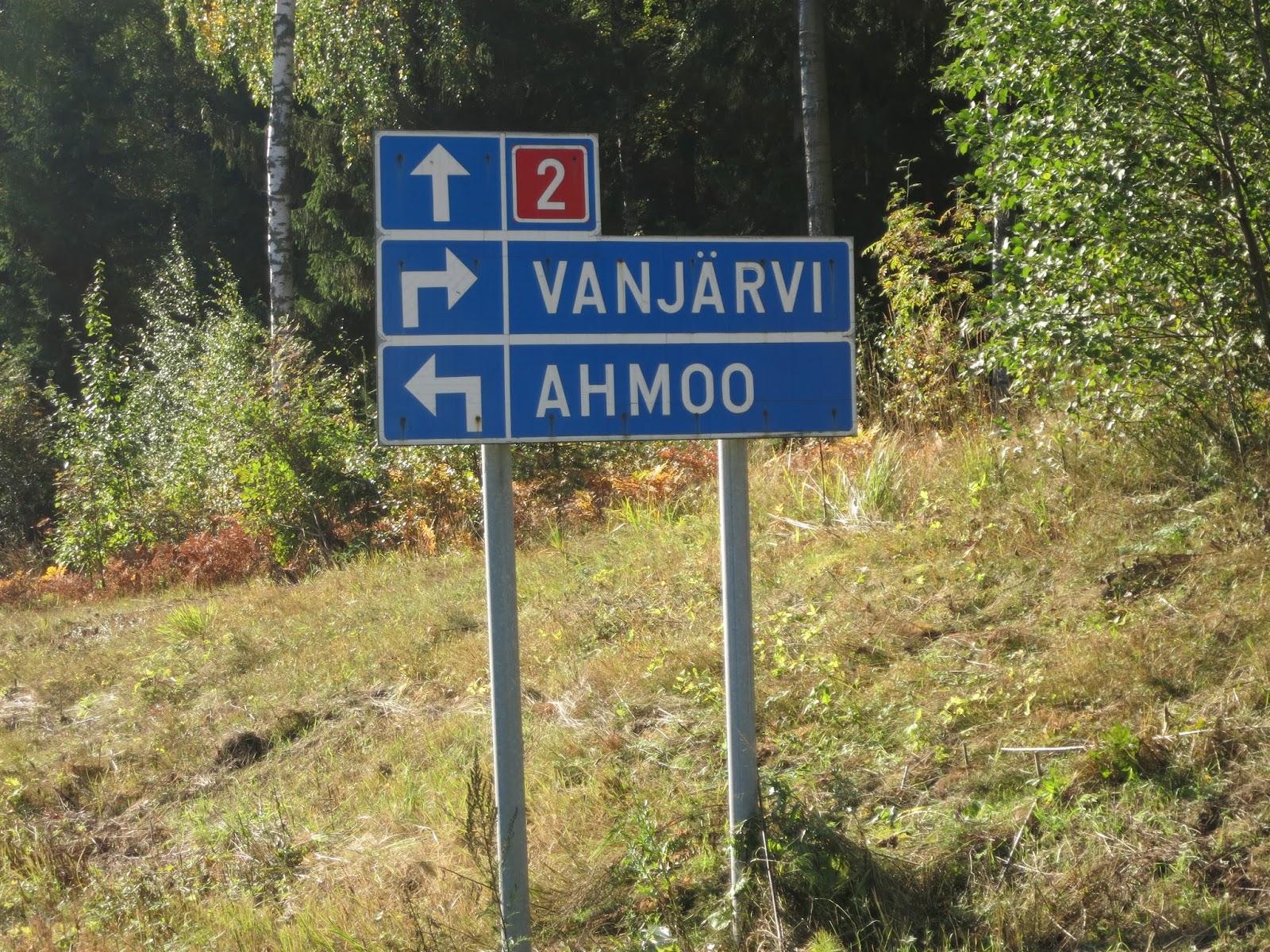
It's probably not funny at all to Finns, but I would love to live in a place called "Ahmoo"
Somewhere in the Finnish countryside
 The Alpkit bags seem great so far. The frame bag takes quite a lot of gear but doesn't bulge enough to rub. I picked the thinnest option, 4cm bulging to 6cm width, as it was for a CX bike. On a MTB you might be able to get away with a slightly wider bag. The 'fuel pod' also worked well, although due to the hydroformed frame shape at the front of the cross-bar on my bike, I could do with the velcro tabs being a little longer, whilst the tab that goes around the stem could be thinner. They only had them in size large when I bought it, so went for that size by default. Nevertheless it's not that big, so I think the smaller option must be tiny with room just for some energy gels or similar. I wasn't sure when I ordered it, but I'm glad I got the bigger size.

The Alpkit "Fuel Pod", size large
Drops bars on a CX bike making attaching luggage to the handle bars trickier. A small-ish dry bag packed no bigger than to fit between the drops works OK, and for this trip I had some much better straps to hold it on. These are from the Aussie firm, Sea-to-Summit, which make some of the most intelligent little bits-and-bobs for camping and outdoor pursuits, as well as some amazing if very pricey serious gear like this very high quality sleeping bag that I reviewed for UKclimbing a couple of winters ago. They were sillily expensive for a couple of nylon straps - about €10 - but the alloy locking buckles on them work very well and didn't loosen despite hours of vibration, particularly riding on gravel road - so as long as I don't lose them they should pay off in the long term!