Friday, October 05, 2012

Terrorism, cliche and teapots.

A friend tweeted a link to Stratfor article called "Terrorism Tradecraft" to me, asking for my thoughts on it. There's no way I can get my thoughts into 140 characters, so instead I might as well blog them here. Scott Stewart who wrote the article should certainly know his stuff, but to me the article is rather representative of unhelpfully pushing ill-fitting phenomena into certain frames. Once 'framed' that way, we might have a pretty picture to look at and study, but the frame shapes how we see the phenomena, we no longer see the shape of the phenomenon itself.

In this case, I can't think of a better word for the frame than "cliche". At home, I have a terrorist teapot. It scalds my hand or dribbles tea down the side, no more than any other averagely functional teapot and, hence, is no more dangerous. It is just a teapot that looks like a terrorist. It wouldn't be funny, and my sister wouldn't have bought it for me as a Christmas present, if we didn't all know what terrorists are supposed to look like. I also know what "tradecraft" means, I've read enough Len Deighton and John le Carré. You're not going to get through Checkpoint Charlie and successfully retrieve the microfiche from the dead letter box without the Stasi picking you out without good "tradecraft". The idea that there is an identifiable "terrorist tradecraft" is a conceit designed to encompass wildly different situations whilst keeping them wrapped up under the neat, if useless, bow of "terrorism". In a way Stewart makes exactly this point in his article but seems to miss the implications of it: he notes that the attack on the US consulate in Benghazi was essentially a small unit military operation. Probably a young infantry lieutenant studying at any decent war college would recognize the "tradecraft" (the tactics) used. What this has to do with, say, Mohammed Sidique Khan or Anders Behring Breivik deciding to attack London and Oslo respectively, I don't really know. If there was "tradecraft" to compare it to, it should perhaps be the Navy SEALs assaulting Bin Laden's house in Abbottabad, or the SAS taking back the Libyan Embassy in London. That the "tradecraft" of Ansar al-Sharia's small unit tactics and Sidique Khan deciding to blow up the Tube are somehow connected is only the result of the frame that we, as observers, put on two different events separated in time and space; the same frame that makes my teapot mildly amusing. I think this frame has much to do with Hollywood now as it does to what, problematically, could be called "real life". We just 'know' what terrorists are like, therefore we then look for things that connect them - in this case their 'tradecraft'. The very obvious danger here is that because we 'know' what terrorists are like, when real life doesn't look like that image, we don't see terrorism - Anders Behring Breivik and Wade Michael Page (the Wisconsin Sikh Temple shooter) being cases in point.

So the concept of "terrorism tradecraft" just seems a pretty useless classification. There is now lots of evidence of particularly bomb making technologies spreading through Jihadi chains - from Iraq to Afghanistan and Pakistan or from one group to another. But of the terrorist attacks seen in the West, both the tactics used and the ways individuals or groups decided on them is too diverse to claim there is a tradecraft somehow indicative of terrorism. I simply don't think it is identifiable as separate from the methods used by other evil/crazy/both dudes blowing people up or shooting them. Breivik showed all too clearly that you do not have to gain bomb making training from al Qaeda to build a successful large bomb. But considering that his bomb accounted for only 8 out of his 77 murders, it wasn't a huge step up from the horrific bombing of the Myyrmanni shopping centre, here in Helsinki in 2002, by the 19 year old Petri Gerdt. Gerdt killed six innocents including a 7-year old child along with himself. There are bad people who want to do bad things, and some will do them. How they do those bad things will differ, there is no body of method we can call tradecraft.

But the cliche doesn't stop on that level; the article notes the importance of "operational security" for terrorists. Alternatively, and less self importantly, this could be called "the importance of not being an idiot and getting caught". Potential terrorists who are stupid, get caught (or blow themselves up along the way). Indeed, the FBI has become unsurprisingly adept at catching really stupid wannabe terrorists - (hint to aspirant but intellectually challenged [that means 'stupid', stupid.] wannabe terrorists: spraying on the internet your hate of the West and love for OBL is not good "operational security", you can have that as a freebie). Calling it "operational security" is spy movie cliche, it doesn't help us define anything. Not being stupid isn't terrorist tradecraft, it is simply not being stupid.


Six years and a day ago it turns out, I wrote about the terrorism industry. Plus ça change... Actually, that was more about the private sector trying to find ways to make money out of governments spending on 'counter-terrorism initiatives' and the like. This is more a question of the academic and para-academic area of "Terrorism Studies"; of which the Stratfor article is (just?) within that field. Some high quality research is being done, and some not so high quality. There is though plenty of discussion on the more meta questions involved in studying terrorism. There is even now a sub-field of "Critical Terrorism Studies" aimed at deconstructing Terrorism Studies - looking at the unanswered but inherent questions in the field (although I trust the irony of creating an industry to comment negatively on another industry isn't lost on the participants). But, as ever, the issues should define the field of analysis, not the field define the issues. Let's keep "tradecraft" in the spy movies and describe what violent political extremists actually do rather than what we would like them to be doing for reasons of analytical neatness.

Monday, October 01, 2012

Mountain biking in Komio

It started with a tweet. Peter from Yeti Rides noted he had found an interesting blog: another Finnish fat bike aficionado who has started blogging in English about trips in Finland. The blog "Duckboards are evil" is great - nice pictures and written with an engaging and lighthearted style; for example: "our unofficially and unintentionally slightly homoeroticaly named duo Metsäveljet was in it's full line up." Metsäveljet means "forest brothers", but the phrase may well have more direct cultural connotations about what the brotherhood of the forest might be getting up to out there in those dark endless woods than my Finnish is up to understanding. Anyway, from my point of the view, one of the best things is that Mr Duckboards-are-evil is Helsinki based, which means his local stomping grounds are mine, so the blog immediately provided me with some new ideas and inspiration to get out.

A view from a hill top, a surprisingly rare thing in wooded Finland.
As you head north from Helsinki up the motorway towards Tampere, the geography of the country to the west changes. Sand is central to this, meaning quite specific local flora and a certain feel to the woods that is specific to the sandy ground. This area known as Hämeen järvilylänkö or the Häme Lake Uplands, isn't really uplands in the way a Brit would understand the word, but it is a pretty wild area with some interesting geography, the after-effects of major glaciation. I've been up that way before with the family for some hiking at the beautiful Torronsuo national park, one of the biggest mires - or swamps - in the country. We also went rock climbing at one of the more esoteric Finnish crags I've been to, the amusingly named Nakkivuori, near Somero. But Duckboards-are-evil sent me to the nature reserve of Komio, for some excellent trail riding. I've been biking a lot - I've recently bought a cyclocross bike (more of which at a later date); but mainly road biking. It was nice to get out my mountain bike and throw it around a bit. The trails there are superb for mountain biking, mainly 'flowy' single track, hardly anyone on them and traversing a geography of "rugged eskers [that] form a characteristic feature for the gorgeous landscape along with sunny and shadowy slope-side forests, clear watered ponds and vast bogs". The eskers form short, but very steep ridges and the trails going up and down them provide challenging riding. The paths going along the tops of them are just wonderful. One helpful by-product of the sandy-esker geography is that despite the huge amounts of rain we've been having recently the trails were well drained and not really very muddy at all.

A lake
I had left a bit late, so only got to ride for a couple of hours - nevertheless its the best riding I've done in ages and reminded me of just how much pure fun mountain biking can be. Thanks very much to Mr. D-A-E for the inspiration/information and keep on blogging.

As slippy as wet ice, these duckboards really were rather evil.
Here's a film I was inspired to make. As I don't have a GoPro or similar, I sort of tied my little Lumix to the handle bars with its mini-bendy tripod. The results were predictably shaky and silly, but I'm not really expecting an Oscar. It does give some idea of how much fun it is though!

Monday, June 25, 2012

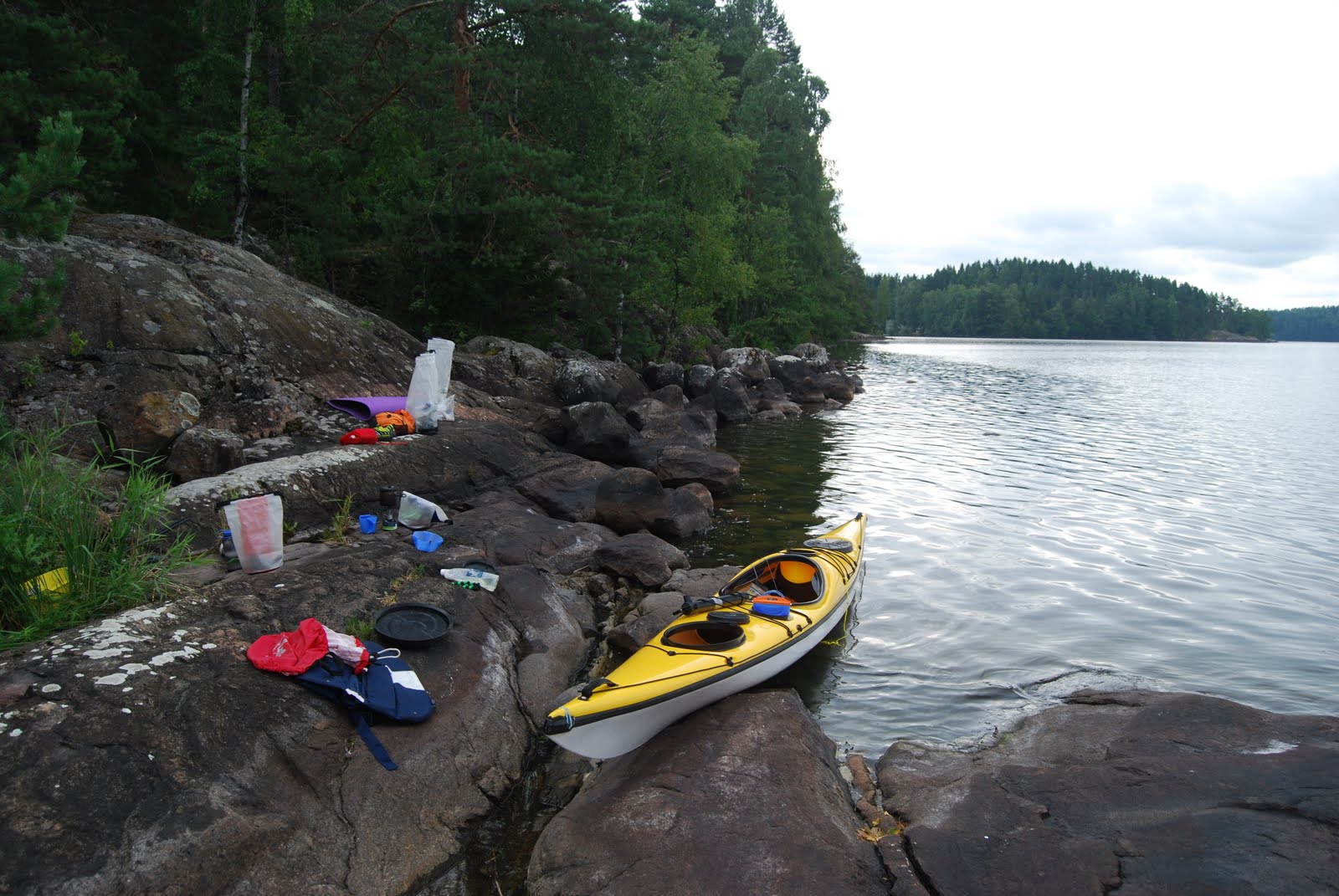
Alpkit in operation - kayak touring in Southern Finland

I haven't been blogging much recently, but when writing up my last post noticed I had uploaded a bunch of photos last summer from a kayaking trip, saved them as a draft, and then had forgotten about them. I've also been meaning to write a review of some Alpkit gear I've been using for some time now so, and as all my Alpkit gear got taken on that trip, I figure I can get two birds with one stone - although not literally as obviously that would a) be cruel and b) I'm not that good a shot.

Unpacking for night one of 3 day/2 night trip
It is almost boring to say nice things about Alpkit because, like motherhood and apple pie, everyone seems to like them and this post isn't going to be much difference. With a direct to the public, internet-only business model, the folks at Alpkit have realised that they need to make customer service an absolute priority and this they do exceedingly well. They must be a pretty busy and fair sized business by now, but still you always feel that it's a personal service and it doesn't matter if you are spending a few quid or many hundreds, your order seems to matter to them. About the worse I can say is that their chosen courier service was a bit hopeless on the last order I made when back in the UK. I nearly didn't get my parcel before coming back to Finland, but Alpkit did what they could do from their end and it turned up just in time.

Two airlock dry bags and the Gourdon dry-rucksack
If there is one problem with Alpkit it's that they are a victim of their own success and have problem keeping their products in stock. Over the years I've on a number of occasions wanted to buy something only to find that they don't have any in stock and aren't expecting more for some time. I presume it is a constant battle for a business that gets its products made in the far east to have enough to meet demand, but to not end up with tonnes of unwanted stuff on their shelves. Nevertheless Alpkit is simply so competitive on price, that as consumer I really don't want to buy, say, a drybag from anywhere else as all other brands seem so expensive. So it's particularly annoying when they don't have what you want in stock as it makes you feel like you are being 'forced' to spend more on an alternative. The fact that they leave the product pages up, but just with a little "out of stock" note when you go to click to buy, amplifies this.

Hiidenvesi
But, moving on to the actual kit I have bought. First, a Gourdon 25 - a drybag masquerading as a rucksack, or vice versa if you prefer. My 25 litre one is small, lightish (and light if you pull the back-pad out), waterproof, has a couple of handy pockets on the outside and best of all is bright orange. Actually, if I'm honest, the best of all thing is that it cost 22 quid. Can't say fairer than that. It works perfectly as a drybag in a kayak, and is fine as a little rucksack (stable enough for mountain biking and even running if there's not too much weight in there).

Midnight on Hiidenvesi
Next, tent pegs. Yeah - I know tent pegs aren't very exciting but short of buying some hugely expensive brand name ones from a camping shop when you need them, its hard to find cheaper but non-trashy or super heavy ones than Alpkit's. I originally bought some of their titanium v-pegs when I bought a tarp, figuring if you had a tarp you should really have Ti pegs to round out your ultralight image. They don't pull out and are light but they can be hard on guylines due to their shape - they have cut the soft nylon guylines I put on my tarp a couple of time. Also, don't try to push them in by foot if you are wearing Crocs. A hole in your Croc (and possibly your foot) will be the result. I subsequently got some of their jolly red aluminium ones; these weight a little more but are more user friendly and are cheaper so you won't get as upset when you inevitably lose one.

Kayak touring is just super-civilised, the marginal cost of a bit more weight is minimal so beer becomes a 'necessity'!
Referring back to my earlier point about stock availability, the next item I'll mention is the Alpkit Numo air mattress. These don't seem to be on Alpkit's site anymore, so it may be that they don't plan to reintroduce them, perhaps connected to the issue of them being very similar to a model made for the American outdoor equipment firm POE by the same factory in China. If this is the case, it's a shame because having slept on the Numo a good few nights now, it is by far the most comfy mattress I've used for camping. I've not used a non-self inflating mattress since family camping as kid (and those ones always leaked!) and its a step up in comfort from even a thicker thermarest style. It also packs down pretty small, is light and, of course being Alpkit, was far from expensive. I used it camping in Glen Nevis last September and it was there that I noticed what others say about this style of mat not offering the same insulation value as Thermarests; it seems that you get convective air currents within the tubes and this takes heat away from your body. The Numo has some insulation the torso area but I found this effect surprisingly noticeable around my feet. So comfy, yes, but perhaps a three season mat at most.

Gamma headtorch in operation
The Gamma head torch is pretty famous now, they are just so ridiculously good value - money for candlepower, nothing comes close. I've had mine three or more years now. It used to spend most of the winter, minus its elastics, attached semi-permanently to my bike helmet. Commuting in winter in Helsinki is pretty dark affair and I like the high position of lights (it has a red blinker on the battery pack at the back as well) on my helmet, in addition to numerous bike-mounted lights. If there is anything wrong with it, I would prefer that the small red LED would come on first out of the secondary front lights. Red doesn't take away your night vision when, for example, reading a map, so it would make sense if you didn't need to cycle through the white and green, to get to the red. The Gamma might not be the best head torch in the world, but at 15 quid nothing else comes close.

Leaving camp for day 2
If drybags work, there's not much more to say about them - Alpkit ones do work, and they cost very little. I have an older one of the simple dry-bags (now I think they are in a lighter material than mine) and one of the slighty more techy ones. These have lashing points that make them great for bikepacking for example. They work, they're tough, they're cheap - not much more to say really.

South to Lohjanjärvi
Finally, I want to give a shout out to Alpkit's little zip pouches. They call them their "Mission packet" which sounds very cool, but actually they are little zip bags, going up in size. I bought them thinking they looked cute but wondering whether I'd ever use them. Of course it turns out that I use them constantly. Particularly the little ring attached to them means you can clip them to something like the key clip inside the lid pocket of a big pack ensuring your wallet and car keys never get misplaced. The biggest one will just fit my MacBook in it, and the mid sizes can stop a paperback getting squashed, make a decent wash kit bag, keep your matches and penknife handy, etc. etc. etc.

Is there anywhere in Finland where the dubious 'delights' of ABC's monopoly of mediocrity doesn't reach?


Portages don't come much easier.

Fantastic weather on Lohjanjärvi.

Breakfast and packing up on day 3

Your - slightly piratical - correspondent, somewhere in a big Finnish lake. 

Thursday, June 21, 2012

The Big Ride. Kangasala-Vantaa, 190 kms.

If you can see your ride from space, it has to be good eh? :)
Some times by mistake, you can end up impressing yourself. I’ve been riding a fair amount so far this spring and summer but mainly commuting and mountain biking; so the urge to ride a bit further on my road bike had been gathering. The family were heading to Kangasala, a small town on the outskirts of Tampere, Finland’s second city on Saturday. Kangasala is about 180 kms north of Helsinki. My original plan based on the weather forecast and general lazyness was to get up early and start riding towards Kangasala, and then when my family caught me up in the car - probably about halfway up - I’d put the bike in the boot and carry on the rest of the way with them. This was not to be though; my better half saying she wanted the whole boot available for the return journey; therefore if I wanted to ride it would have to be home, and the whole way. My protests about this being quite a long ride (Google maps suggested the most direct route home would be 150 kms) were dismissed as whining and that I shouldn’t be looking for easy ways out. 
Crossing the river in Valkeakoski
And so the dice were cast. I left Kangasala under blue skies and the warm mid-summer sun early in the afternoon, with Wittertainment playing quietly in my ears (hello to Jason Isaacs). My first decision was which side of lake south of Kangasala, Roine, to ride down. The highway back to Hämeenlinna goes on the east side, but driving up that road it was straight, relatively busy and narrow; hence not a great bike route. So I took the west side where a quiet and pretty road runs down to the mill town of Valkeakoski. Crossing the bridge in Valkeakoski seemed like the first target reached. Beyond the town I carried on down and over the attractive bridge crossing Rauttanselkä. This was probably the scenic high point of the ride; classic Finnish lakeland scenery.
Rauttanselkä, filtered via Instagram
My route then took the old highway down to Hämeenlinna; this section was distinctly weird, as it’s a big wide straight highway that now, with the motorway being so close by, has virtually no traffic on it. Maybe I’ve been watching too many episodes of the Walking Dead recently, but deserted roads are a bit spooky. The odd car trundling past was actually appreciated, in that it reminded me that I wasn't the last man standing after the apocalypse.  Such thoughts were dispelled on reaching the relative bustle of Hämeenlinna where, beyond the odd drunk, no zombies were spotted. I could have continued on the old highway straight back home but its straightness and proximity to the motorway make for unattractive riding, so I took a diagonal through the town leaving its southeast and taking back roads to Turenki. Leaving Hämeenlinna I had a minor disaster - pulling my food bag out of the back pocket of my jersey, the plastic split and jelly beans and cereal bar chunks were scattered across the road. Fortunately, coming into Turenki I spied a Lidl still open so was able to buy more jelly beans, plus some other snacks and drinks. A supermarket carpack might not be the most beautiful of picnic spots but I was happy just to loll around on the grass for a bit. 

Chocolate milk refueling stop; Lidl in Turenki
South from Turenki the roads got quieter and more attractive. I skirted east of Hyvinkää and eventually made it to Jokela for another refuelling stop. A couple of times Jokela has been the far end of a loop from home, but getting there on saturday felt like being nearly home - no more need to check the map for example. I had been watching clouds building in the southwest all day, but the last 40 kms were ridden under thick grey and the last 15, with the rain starting to fall. By the last ten or so, back on the old highway, I was bored and wanted to be home, and the rain didn't help. Nevertheless, on the positive side I wasn't getting any of the cramps or back pains I've had towards the end of long rides in the past.

A pretty knackered me, back home at last.
So too summarise; 190.48 kms ridden. Time riding: 6:39.25, plus an hour or so split between four off the bike rests and stops to look at the map properly. A 28.6 kmph average speed, of which I'm quite proud. From the time multiplied by my average cadence of 76, I think I turned the pedals 30 400 times! 5.5 ltrs of liquids drank (2 litre bottles on the bike, bottles refilled once; + a litre of choccy milk and a bottle of coke). One Apple pastry, two energy gels, about 100 grammes of peanuts, and 200 grs of Lidl's finest American style jelly beans (which were great) consumed. I was glad I didn't have to do it again the next day, but it was a great way to spend and afternoon and not as hard as I thought it was going to be. In particular I was pleased that I kept my pace up at a decent level for the whole trip.

En route - a Kirkonkylä (church village), can't remember which one
I don't really have much practical advice to give if anyone else fancies trying a ride along these lines, but I can give a little context: I've always had bikes, but I've never raced or been in a cycling club, so for me a long bike ride like this is more akin to my climbing and mountaineering adventures than a sporting event. I know many keen cyclists will have done many runs of this kind of length, but I think it is the second longest ride I've ever done after the Kallaveden Kierros, and by far the longest solo ride where you don't have the huge advantage of riding in a group. 


I've not really thought about it before, but road bikers were the original lightweight fanatics, long long before moutaineers and backpackers got in on it. You look at the weather and work out the minimum of gear you need for the worst it could be and then just figure you'll keep riding to stay warm if it does crap out. There isn't much room for packing 'just in case' gear as you can with rucksack-based trips. For this trip I rode in bib shorts and and a short sleeved jersey and had an ultralight windproof/water resistant jacket in my saddle bag. Also in the bag, I took some allen keys, a chain breaker (I've broken and seen friends break chains in the past, so figure it's worth it, others disagree) and two spare tubes. Normally I just carry a single tube, but being alone and someway from home, two seemed prudent even if punctures seem to happen rarely to me. Then my phone, which also serves as my camera and gps (in a plastic bag), iPod, food, cut down map, pump, ibuprofen tabs and some money plus bank card went in my jersey pockets. My only 'luxury' I guess was a small cable lock. Finns are a trusting lot but my knee-jerk Englishness still makes me think someone will try and steal my bike the second my back is turned, so for shop stops it's worth it for me. My bike behaved impeccably. Some say aluminium frames like my BeOne give a harsh ride on long rides although I can't say I've noticed this over my old, steel framed road bike. Having a decent track pump means I can now pump the tyres up to near their maximum pressure, which makes them roll really fast. And when you've got a lot of miles to go, that's what you want!


Monday, May 07, 2012

"Ice Moon" by Jan Costin Wagner

I've just finished reading "Ice Moon" by Jan Costin Wagner. I have this urge perhaps stemming from my PhD studies to read just about anything I can find about Finland written English. This used to be just out of interest or to gain more knowledge of the country, now as often as not it's to see what other non-Finns have to say about Finland. Wagner is a German married to a Finn, and the book is set in Finland with just a couple of marginal scenes in Sweden and Germany.

It is crime fiction I suppose, but it was first published in German in 2003 and then translated into English (by the superbly named John Brownjohn) and published in 2006 so that makes it relatively early in the whole 'Nordic noir' thing. It doesn't have much in common with some of the big hits I've read of Scandinavian crime writing; for me at least it was more engaging as a love story than as a detective story. Although in this respect it does fit into the traditional literary Nordic gloom as one half of the loving couple has just died. We observe the love of the novel's main protagonist in his grief for his recently deceased wife.

It is a very quiet book. The murderer is quiet, his victims die silently, the Finnish police say little to each other and the hero of the story is cut off from the world by his grief. I don't think they even mention any police cars turning their sirens on. The first snowfall of winter comes during the book making the world even more silent. I don't think anyone draws their gun at any point, don't expect action or violence. Perhaps this is realism for a Finnish crime novel.

The author's prose is sparse, he doesn't dwell too much on describing the settings either natural or man-made. Naantali, where much of the action takes place, is one of the more interesting small towns in Finland but there is little description of it in the text. I've read a couple of books by Camilla Läckberg set in Fjällbacka, in Bohuslän on Sweden's west coast. I found the books slightly annoying, but she does do a good job of describing Fjällbacka and its environs. Wagner doesn't do this for Naantali or Turku - indeed if you haven't visited them you won't have much of an image of them after finishing Ice Moon. A novel should not feel the need to be tourist information for the place in which it is set, so for me a bigger problem was that the story's timeline didn't make much sense. It starts in summer and ends in winter, but there only seems to be a week or two passing in between. The murder cases seems to play out relatively quickly - the first murder is still very much being actively investigated when the second and then the third happens. The events in the novel feel like they take place in a couple of weeks, but somehow it goes from midsummer to the lakes being frozen enough to walk on. I've longed toyed with the idea of writing a novel set in Finland - 'write about what you know' and all that - and always felt that the passings of the seasons and how nature changes would be the backdrop to a story of people. I think that is what Wagner has tried but he seems to have set two different clocks that are running at very different speeds. More than a detective novel, Ice Moon is a character study and it feels a little too much like the changing seasons are just being used as a literary device to amplify this.

One other minor criticism also occurred to me, although it is only likely to be of interest to Finns or those who have made some attempt at learning Finnish; the main character's name: Joentaa. It sounded odd to me and I asked my wife, she said she it doesn't really mean anything and she's never heard it as a surname. A quick look on Finnish Google supports this, with nothing coming up except references to this book. Perhaps the author picked a surname that sounds Finnish but isn't really on purpose as it is an odd mistake to make when all the other names sound real.


Sunday, May 06, 2012

Kill your television

I like Finland more than I claim; don't tell anyone - it might damage my image as moaning, snarky foreigner. But a constant source of both amusement and irritation is how Finland presents itself to the world and wishes to be perceived by the world. There is the "Finland" of tourist info office, of the tweets of Alex Stubb, Minister for European Affairs and Foreign Trade, and indeed of many proud Finns when they tell foreigners about their country. Then there is the Finland in which I live. Sometimes the two line up, at other times they don't. 

This many TVs - presumably commercial waste rather than domestic?
The last snow melted in the shady corner of my garden last week, and I swam in a lake on Vappu (Mayday) eve that I was told had ice still floating in it three days earlier (not hard to believe once you got in). As the snow melts but before the vegetation grows it's hard not notice the strange fruit that line the roadsides. The tourist info will tell you of "unspoilt forests" and how important those dark woods are to the Finnish people. I'm sure this is all true, although it doesn't seem to stop many Finns throwing their unwanted shit into those now slightly less unspoilt forests.

Builder's waste, or just a thorough spring clean of someone's house?
 Of course douchebaggery knows no borders, but fly tipping and other forms of disgusting littering are a big enough problem in Finland that it riles me every time I hear people mentioning a generic national love of nature or those unspoilt forests.

And for anyone who didn't get the title, shame on you for your insufficient knowledge of the early 90s British indie scene. Grungey Americans, don't forget - the Grebos of Stourbridge beat you to it. ;)

Wednesday, April 11, 2012

The People's Mujahedin of Iran and their friends in the west

The BBC World Service has a remarkable documentary available currently on the People's Mujahedin of Iran (PMOI). Most non-Iranians will have not heard of the group, but in short they were anti-the Shah and supported the revolution against him - it's important to remember that it's only really subsequently become labelled the 'Islamic Revolution'. At the time there was a considerable radical left-wing and secular dimension to the uprising alongside the later to be dominant Islamists. The Islamists under Khomeini subsequently turned on their previous leftist allies, including the PMOI, and the group went into exile in Iraq where they allied with Saddam Hussein against the regime in Tehran. The documentary does a pretty good job of explaining the general weirdness of the group, leaving aside their politics. It would appear to resemble a cult more than a political party now, with at least hard to dismiss claims of mistreating its members who wish to leave.

Nevertheless the most noteworthy dimension to the documentary is the reporting on the PMOI's lobbying within the United States. The group was listed as a terrorist organisation in the 1990s by the US government and remains so to today. In Europe it has been de-listed as a terrorist group, although its fund raising within Europe appears to be dubious to say the least. The BBC interviews numerous prominent Americans who are now part of the PMOI's campaign in the States to be taken off the terrorist group list; they include Republicans and Democrats, and many former senior officials and soldiers. It gives a fascinating insight into this world: some of those interviewed openly admit to not knowing anything about the PMOI before being approached to speak at their events in return for (considerable) payment. Nevertheless, these personalities seems to have taken their duties seriously and are openly pushing for the PMOI to be brought in from the cold - believing clearly that their position against the current regime in Iran* means their past sins (including involvement in the hostage taking of the American diplomats in Iran all those years ago) can be forgiven.

Perhaps the enthusiastic cynicism of some in the American political world should be no surprise to us, but it's always interesting to see how this sort of lobbying for non-domestic interests works. What is far more alarming is listening to the non-mercenary supporter of the PMOI - a former US colonel who dealt with them in Iraq when the US took over their camp there - who seems to be seriously suggesting that this exile group, who have not been in Iran for nearly 30 years and that has its own cultish leanings, could be the core of a future Iranian regime when the current leaders in Tehran fall or are deposed. I expect I'm not the only one for whom, on hearing this, the name Ahmed Chalabi immediately springs to mind. People really don't learn from their mistakes do they?

*Incidentally, some reporting links the assassinations of Iranian nuclear scientists to Israel via the PMOI. This has a certain attractive logic to it - if Israel is behind the assassinations as seems likely presumably they would need some sort of proxy in Iran, plus the PMOI has been responsible for bring to light some of Iran's secret nuclear facilities. Nevertheless, the PMOI has denied any linkages to Israel, there is little hard evidence linking Israel to the attacks so far, and the PMOI are far from being the only Iranian domestic insurgents/terrorist groups - there Baluch and Arab separatist groups in Iran for example as well.

Wednesday, March 28, 2012

When cities die

Years ago, I was reading the ice climber Will Gadd's blog. Will had a post linking to photos of Detroit where nature was reclaiming parts of the city where people had basically left. I was so impressed by the photos I wrote a brief post myself linking to the same material. That was in 2007; since then I think the emptiness and devastation of parts of Detroit has become quite well known. I've even seen it used as a back story on some cop show where one of the "urban explorer" got bumped off for reasons I no longer recall. I remember hearing that some in Detroit are really quite annoyed now about the stream of journos and photographers who arrive from around the world to see the 'ruins' of a city where I suppose many hundreds of thousands do still live.

Anyway, today's Slate Culture Gabfest discussed a recent piece in the NYT Magazine called "Jungleland" on what's left of the 'Lower Ninth' in New Orleans. Slate hadn't got all their links up when I first checked out their show page, so I just went to Google Earth to get some idea of where the Lower Ninth is and looks like (I've never been to New Orleans). On the satellite imagery things look quite normal from some way above: lots of houses are visible, some parks etc. It just looks like many other spacious spread out American suburbs. But going to Google Maps and using Streetview, the desolation of the area is starkly apparent. Many of those roofs visible from above are on abandoned and derelict houses. Some people have rebuilt and are living there, but most of the houses were simply washed away, some of the inhabitants with them, and there's just scrub and rubbish left behind.
View Larger Map This is 2403 Flood Street, I've chosen it completely by random after clicking up and down various roads in the district. Spin around using streetview and you'll see the one little white house there, shiny and new with what looks like a wheelchair ramp outside, and then its surrounded by something that is going back towards wilderness, but as the Slate discussion revealed - its not even 'natural' wilderness, as the area is becoming dominated by mono-cultures of invasive species.

It is one of the saddest things I've ever seen.