The Danish budget airline Sterling have just announced that they will stop flying from Helsinki in August. They started two months ago. So that didn't last very long did it? This follows hard on the news that Swedish budget carrier FlyMe are also to stop linking Stockholm and Helsinki.
Some time last year I wrote an article for Ulkopolitikka magazine about how Finland has virtually missed the low-fare airline revolution that has swept the rest of Europe. As some one living a couple of thousand kilometres from their home country obviously airline fares are a source of constant interest. The gist of the article was that EasyJet and Ryanair have done more to Europeanise the UK than every EU policy drive and public relations effort combined. The foreign is a lot less foreign when it costs you 99p + tax to go and visit.
Sterling say simply that they haven't sold enough tickets. I wonder if Finns just don't want to travel or are happy enough with the prices offered by the flag-carriers? I would be interested to know to what extent "Summer cottage culture" lowers demand for flights out of the country. I definitely have met quite a few middle class Finns who spend their summer holidays over-looking a lake somewhere in the quiet hugeness of the country rather than heading for southern beaches and sunshine as their UK equivalents would. Meanwhile I'll be taking SAS to the UK at the end of this week where, despite not offering budget prices, you don't even get some booze and free sandwich anymore.
Monday, May 22, 2006


Thursday, May 18, 2006
Somalia: unravelling the threads of the Mogadishu fighting
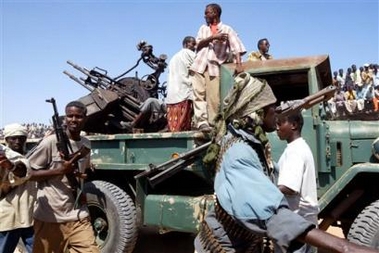
The extensive fighting in Mogadishu over the last week has brought Somalia back to international attention for a few days. Described as “a proxy battle between al-Qaeda and Washington”, this would seem to be over-egging the cake but not completely wrong.
The fighting is between a bunch of Mogadishu warlords who have delightfully re-branded themselves the “Alliance for the Restoration of Peace and Counter-Terrorism” (who might as well have just gone the whole hog and called themselves “Team America, F*ck Yeah!” - a joke for the South Park fans, please ignore if you aren't!) and the militias of the “Islamic Courts”. Connecting the courts to al-Qaeda is a stretch, as they have only recently and rather tenuously been connected to local Jihadi activists. The al-Qaeda affiliated Jihadi group in Somalia that people who are interested in these things tend to have heard if is al-Ittihaad al-Islami (AIAI). It appears to have its origins in the spread of Saudi-sponsored Salafi ideas to Somalia in the 1970s, and emerged in the 1980s as a party of dawa (preaching). It was not until the collapse of the Somali state in 1990 when Siad Barre was deposed that they began to take up arms. They involved themselves in the ethnically-Somali areas of Ethiopia in the 1990s committing acts of terrorism against the Ethiopian state. Any interest in the group in the West seems only to have come once they involved themselves with al-Qaeda operatives in the mid-1990s who were preparing for the bombings of the US embassies in Nairobi and Dar es-Salaam in 1998, but it was their acts in Ethiopia that led to their downfall. In 1996 and early 1997 the Ethiopian army took advantage of the fact that Somalia had no government to complain and entered the country attacking AIAI’s camps and killing many of its members. Since that time AIAI has faded from sight; some still believe it exists as an organisation but the Crisis Group does not believe this is the case (p.9-10) – pointing out that many of its former leaders have now taken up public and non-revolutionary positions in Somali life. One of still radical former-AIAI leaders, Hassan Dahir Aweys, seem to be the ideologue leading Aden Hashi ‘Ayro, the leader of a new, nameless Jihadi group which is active now in Somalia and has been linked to numerous murders of foreign aid workers in the country and other terrorist acts. ‘Ayro and his militia is also said to be now sheltering foreign al-Qaeda members in Mogadishu, including individuals that the US has sought ever since the embassy bombings.
The Islamic or Shari’a courts that are providing a type of justice system across southern Somalia are in the words of the Crisis Group: “widely touted as the most visible evidence of the creeping influence of Islamist groups. Most courts, however, are less a product of Islamist activism than of Somalia’s two most common denominators: clan and the traditional Islamic faith.”(p.19) And further that: “their heterogeneous membership and the diversity of their supporters mean that attempts to label the Shari’a system ‘extremist’, ‘moderate’ or any other single orientation are futile. In reality, the courts are an unwieldy coalition of convenience, united by a convergence of interests.”(p.21) They have gained much public support even from those who really do not agree with their conception of Shari’a because they have brought a degree of order to a lawless society, paralleling in many ways the rise of the Taliban in Southern Afghanistan in the mid-90s. What started as independent courts generally operating for distinct clans has become a wider system led by “the Supreme Council of Islamic courts”. Individual courts contribute militia forces to make up one larger and powerful fighting force. The Supreme Council is led by Sheik Sharif Ahmad who says the courts are not supporting foreign Jihadis: “There are no fugitives from Al Qaeda or any other organization, as the US and Ethiopian intelligence services are claiming.” But the Crisis Group research suggest the opposite – despite having denounced ‘Ayro’s group in late 2004, the Supreme Council in 2005 accepted him becoming the commander of one the sub-militias contributed to the over-all Court system’s forces.
This makes its hard to take Sheik Sharif at his word, and gives the “Team America” warlords a link to hold onto as they pursue their own interests under the banner of counter-terrorism. I will return to this issue in another post, because the role of, and the divisions within, Somalia’s fledgling transitional government deserves further examination as does the US’s policy.
Wednesday, May 03, 2006
5 truths about Darfur
One danger of using Google to do research is that you end up reading stuff that is interesting but not actually what you were looking for. Anyway I came across this eminently sensible article on Darfur from a week ago in the Washington Post. Well worth a read.
Their five truths about Darfur are:
1 Nearly everyone is Muslim
2 Everyone is black
3 It's all about politics
4 This conflict is international
5 The "genocide" label made it worse
You could maybe argue the toss over the last one, but otherwise its spot on.
Their five truths about Darfur are:
1 Nearly everyone is Muslim
2 Everyone is black
3 It's all about politics
4 This conflict is international
5 The "genocide" label made it worse
You could maybe argue the toss over the last one, but otherwise its spot on.
Friday, April 28, 2006
A British Jihadi in Iraq?
I only recently came across this interesting story in the Times. A British student in Iraq, Mobeen Muneef, gets 15 years from an Iraqi court for a visa violation - i.e. he entered Iraq without one. That would indeed seem a very harsh sentence, but of course he isn't really being punished for the visa offence. Both the Iraqis who convicted him and his family and his legal team trying to defend him say that the length of the sentence is to serve as a warning to other foreign Muslim who want to come to Iraq to join the insurgency. The only difference is the Iraqis say he was fighting with the insurgents and his supporters say he wasn't.
Of course one newspaper story is not a fair trial but the evidence against him as put forward by the report is pretty damning. He was seen handling weapons for insurgents who then fired at US troops as they chased Muneef, he entered the country illegally from Syria where he had been studying for some years, he was in Ramadi - not a very safe part of the country for a foreigner, and allegedly he had traces of explosive on his hands.
His family and defence team seem to be pushing a risky line by saying that he shouldn't have been charged for the visa violation. Surely, the alternative is to have been tried by the court of being part of the insurgency - a crime that could lead to the death penalty. They are also complaining that he has been held by the US in Iraq rather than in an Iraqi prison. After the Abu Ghraib scandal led to changing some rules, I would imagine that being held by Americans is actually the better option to being held by the Iraqi government.
The article also states that "at least" eight British men have died fighting for the insurgents, including three as suicide bombers. There hasn't been much reporting on that - I might dig around to see if I can come up with more information.
Of course one newspaper story is not a fair trial but the evidence against him as put forward by the report is pretty damning. He was seen handling weapons for insurgents who then fired at US troops as they chased Muneef, he entered the country illegally from Syria where he had been studying for some years, he was in Ramadi - not a very safe part of the country for a foreigner, and allegedly he had traces of explosive on his hands.
His family and defence team seem to be pushing a risky line by saying that he shouldn't have been charged for the visa violation. Surely, the alternative is to have been tried by the court of being part of the insurgency - a crime that could lead to the death penalty. They are also complaining that he has been held by the US in Iraq rather than in an Iraqi prison. After the Abu Ghraib scandal led to changing some rules, I would imagine that being held by Americans is actually the better option to being held by the Iraqi government.
The article also states that "at least" eight British men have died fighting for the insurgents, including three as suicide bombers. There hasn't been much reporting on that - I might dig around to see if I can come up with more information.
Thursday, April 27, 2006
Finally, the global oil market is working as it should...so American politicians want to shut it down.
It has been with great interest that I’ve read the ‘high price of gas’ discussions in the
Instead of the naïve and useless (in terms of reducing the price of gas right now) ideas being presented by various Congress men and women, such as calling for taxation of oil corporations ‘windfall profits,’ opening up the ANWR for drilling, or giving every American a $100 gas rebate check, in my dream world of ‘what ought to happen’ I see this: All congressmen and women would together – that way no one gets punished more than the other at elections – tell the public: This Is How Capitalism Works! Supply decreases (or even the expectation that it does) and price goes up.
Admitting the obvious, that the market is working exactly as it should and needs to be, is clearly beyond the American political elite. That the American political establishment reacts like this is not surprising. The political history of the country is littered with examples of a retreat from international free trade (liberal capitalism) when important domestic constituencies are threatened.
It is unfortunate that the political elite in the
What does this mean for the EU and
Thursday, April 20, 2006
Hollywood Generals?

Charly’s ruminations on American generals from last week means that I just can’t help myself and I’m going to have to link this article from the Telegraph. It doesn’t matter how Atlanticist and pro-American us Brits are, even when the US has so few other friends, it won’t stop us from being snobs. It would seem that senior British officers are sniggering at their American comrades’ shoulder holsters. Brigadier Alan Sharpe, whose credentials would seem to be impeccable as the US gave him a Bronze Star for his work in Iraq, said there was a “strong streak of Hollywood” amongst the US generals he worked with.
It’s perhaps a cliché that the British Army are superb peacekeepers whilst the Americans aren’t – but like other clichés maybe there is some truth in it. An Estonian officer who had served in Baghdad with the Coalition told me the same (and also that the US reservists were much better peacekeepers than the regulars). Another contact who is a serving British officer told me of his time as a KFOR liaison officer with the French in Mitrovica (northern Kosovo) and how the French were “gobsmacked” when he used to stop to chat with the locals. Perhaps the practice provided by ‘policing’ the Falls Road during the troubles, and having bottles of piss thrown at you on the good days and bottles of burning petrol on the not-so-good-days, really has taught the British Army some valuable lessons.Tuesday, April 18, 2006
If People Die in Darfur and You Aren't Told About it - Do They Still Die?
I woke up today determined to write a brilliant analysis on superpowers and the media. Rather, having a range of studies and reports floating in my mind, I could not help but think of the ‘Be a Witness’ campaign and video I saw some time ago. The ‘Be a Witness’ video castigates the major American TV news providers for, well, ignoring Genocide in Sudan (where about 400,000-800,000 people have died in the past three years, with another 2 million becoming refugees)
While I had far loftier goals in mind I could not shake the sheer mental violence of knowing that in June 2005 the combined power of CNN, CBS, ABC, MSNBC, Fox News, and NBC was used in the following way: 485 stories on ‘the Runaway Bride’ (she didn’t show for her wedding, faked her own abduction); 6248 stories on Michael Jackson; and, 1534 stories about Tom Cruise (and his current fiancée Katie Holmes).
Going to write this entry I checked out Google News and was offered further proof on the true gift of some media editorial boards to retain their laser-like focus on the truly important. One of the top five news stories was, ”Tom [Cruise] to eat Katie’s [Holmes] placenta.” Fortunately there were only 131 articles on that subject. In comparison, whether the
Thursday, April 13, 2006
More Chad - last for today

Earlier reports that a French Mirage fired warning shots at the rebel column advancing on N'Djamena seemed to have changed into them dropping a bomb. According to the French MoD spokesman, this was OK as it "landed in the sand" and didn't hurt anyone, it was just a warning bomb. The idea of warning shots is hardly new, but a warning bomb seems, well, you'd be pretty silly not to take the point.
Deby is claiming all of the capital is under his government's control and journalists were shown a relatively small number of dead bodies said to be rebels that were clearly designed to make this point.
I have only just noticed, but the rebel group being called in English "the FUC" is about the only funny side to this story.
Subscribe to:
Posts (Atom)

